Saturday, April 19, 2014

MARSEILLE BRIGHTENS UP WITH ART, NATURE WALKS AND SOAP

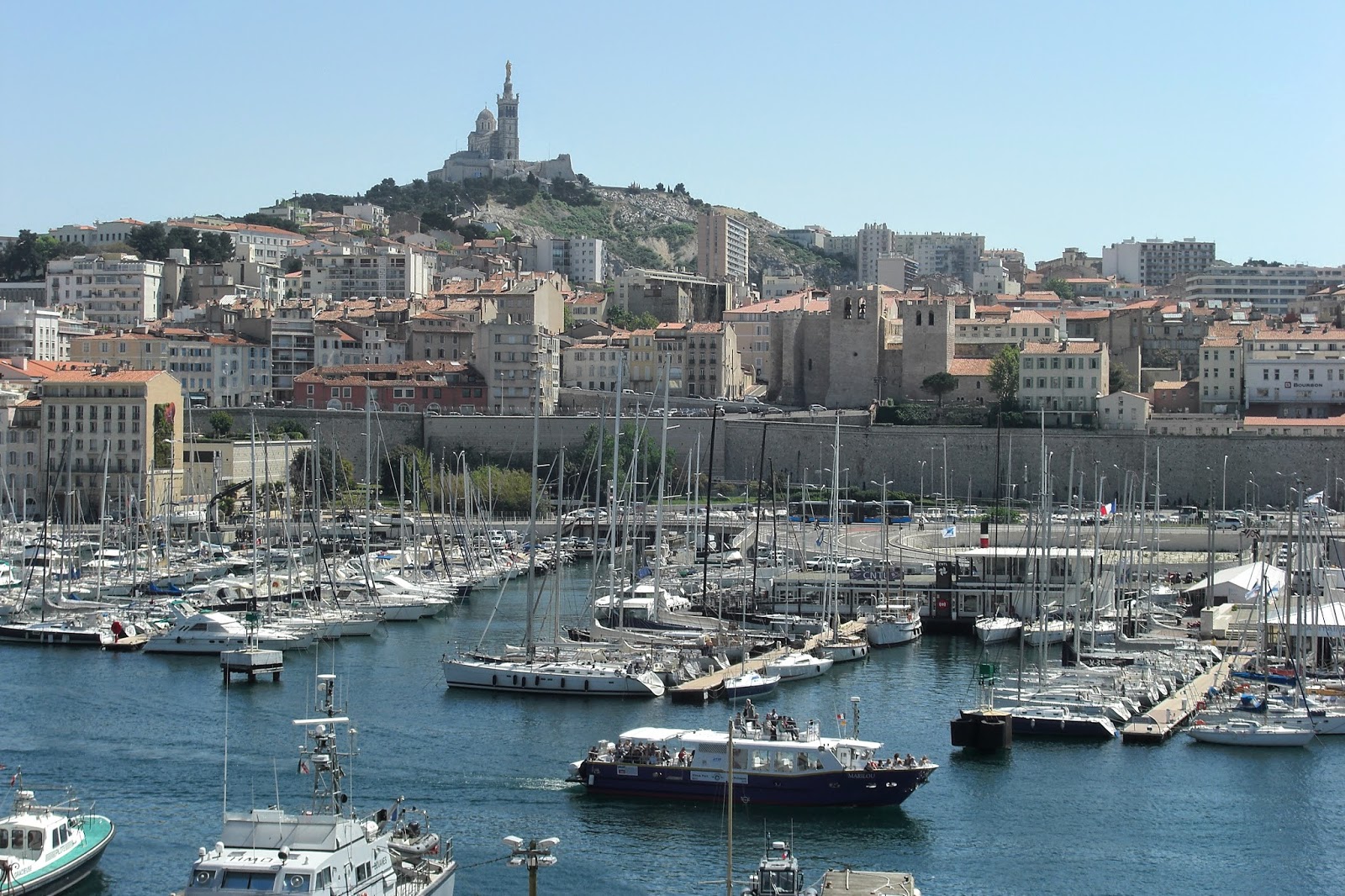
The Vieux Port (Old Port) of Marseilles
“Follow your nose,” said the lady, when asked for directions to the Savonnerie de la Licorne (soap factory and shop). “You will smell it before you see it.” 

The delicate scents of lavender, rose, honey and lily of the valley led to a shop whose facade was covered in graffiti. Inside, a variety of soaps were artfully displayed in a small space, while in the busy atelier behind the shop, workers operated traditional machines that dated back 100 years or more.

The Savonnerie, in the once gritty but now increasingly fashionable Cours Julien neighbourhood of Marseille, reflects the city’s past as a producer of fine soaps. But as the shop currently welcomes tourists from all over the world, and as its "graffiti-embellished" location turns trendy, the Savonnerie can be seen as a sign of how Marseille is changing.

Soap in the city.
This bustling southern French city has embarked on a wide-ranging restoration and beautification programme, and is transforming itself into a popular destination for art-lovers, nature enthusiasts, gourmands and shoppers. Thousands of tourists have in fact discovered Marseille since it was designated the European Capital of Culture in 2013.

“That label was very important for us,” says Marion Fabre, the press attaché for the city’s tourism office. “Because of this, we were able to get support from the European Union to move ahead with many projects.”

The projects included the opening of four impressive new museums and the renovation of several others, which helped to attract a record 5.5 million tourists in 2013, according to officials.

MuCEM
In addition, despite the city’s reputation for gang-related violence and other ills, some 1.15 million cruise-ship passengers passed through Marseille last year, up from 19,000 in 1995.

“People are realizing that Marseille is a good place to do everything,” says Fabre. And the city really does have much to tempt visitors. The most notable addition to Marseille’s cultural offerings is MuCEM, the Musée des Civilisations d'Europe et Méditerranée (European and Mediterranean Civilisations Museum) that opened last June.

Housed in an architecturally stunning building that’s linked to the city’s restored Saint Jean Fort by an aerial walkway, MuCEM is the first museum in the world entirely devoted to Mediterranean culture. The aim is to enable visitors to “discover and better understand the societies in which we live”, say the curators.
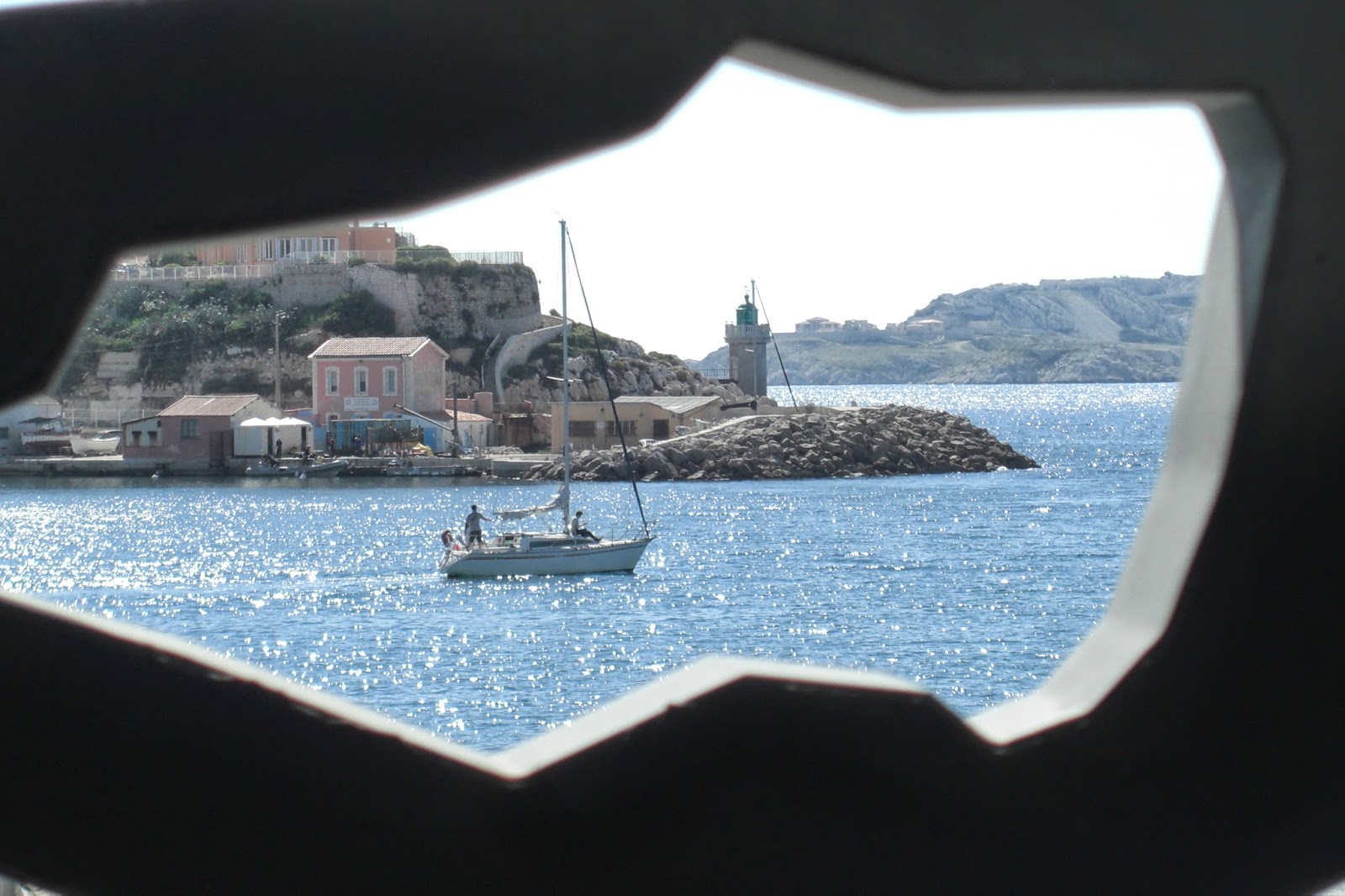
One of the views from MuCEM.
Designed by Algerian-born architect Rudy Ricciotti, the building capitalizes on its location above Marseille’s famous Vieux Port, with museum-goers able to enjoy spectacular views of the sea and islands in the distance. The exhibits might not be much to write home about, as you can see similar items in many other museums, but the building itself will stay in one’s memory.

On the other side of the Vieux Port, both the building and displays are impressive at the Musée d'Histoire de Marseille (Marseille History Museum), which reopened in 2013 with a modern new design, 30 years after it was created. The museum is built around an archaeological site where artefacts of the city’s history were discovered, testament to Marseille’s ancient Greek past.

Here, thematically organized objects, films, and interactive video installations take visitors on a journey through 2,600 years of history, showing the city’s timeless links with the Mediterranean Sea. The remains of huge boats, painstakingly reassembled, are among the central items of the collection.

The remains of an ancient boat.
“Thanks to scientific research and documentation, all these collections recount the lives of the men and women, famous or unknown, who have been involved in the making of the city’s history,” says Laurent Vedrine, the head curator.

The Musée d'Histoire is one of 20 museums now present in Marseille, with some exhibiting modern or ancient art. The Vieille Charité, a former almshouse that now houses several museums and a cultural centre, is currently hosting an intriguing show titled “Visages” (Faces), with paintings by 90 artists including Picasso, Magritte and Warhol, that runs until June 22.

If one gets tired of looking at exhibitions, however, one can opt for gazing at nature’s own art – in the renowned Calanques National Park, just outside the city.

Given protected status just two years ago, in May 2012, the Calanques form Europe’s largest National Park and is the first on the continent to include a land, marine and suburban area, being the gateway to Marseille with the city’s nearly one million inhabitants.

Part of the Calanques National Park.
It took years of discussion and action for the 5000-hectare locale to achieve its status, but now area residents and visitors can feel good knowing that the park will be preserved for future generations who will also be able to enjoy the breath-taking landscape and biodiversity.

Birds, lizards and butterflies are some of the creatures  that one comes across while hiking through the limestone “wilderness”, and when one treks down to the sea, one can spot turtles or, if lucky, unusual fish such as the Corb.

Marseille’s old urban areas are also being preserved and upgraded. One of the biggest symbols of this is the huge mirror-ceiling by English architect Norman Foster covering the pedestrian plaza at the top of the Vieux Port.

A vendor sells Marseille soap at the Vieux Port.
Around the Port, vendors in traditional costumes sell Marseille’s most famous product - yes, the soap. And back at the Cours Julien district, tourists can take a tour to see how it’s made.

“We mix vegetable oil with soda and add different ingredients to make unique soaps that feel great on your skin,” says the director of the Savonnerie de la Licorne, Serge Bruna, as he leads the way through the shop and factory. 

As workers cut and stamp the sweet-smelling products, Bruna explains to visitors that the Marseille soap industry was created in the 16th century and that by 1786, there were 48 soap factories employing 600 workers, with an annual production of 76,000 tons.

The soap is packed and ready to go.
Manufacturing methods evolved during the 1800s, producing sought-after soaps made with olive oil or palm oil. Nowadays, few active soap factories remain in Marseille, but the city remains linked with the product, and soaps can be bought in several specialty shops in the touristic areas. Bruna’s artisanal products are aimed at the luxury market and sold in European countries, China, Japan, the United States, as well as in Marseilles itself.

Indeed, as the Mediterranean city tries to scrub its image, it seems as if the smell of vanilla-scented soap is everywhere. - L. McKenzie & J.M. De Clercq


From grafiitti to gentrification ...
And natural beauty.

Tuesday, April 1, 2014

‘PABLO’ LOOKS AT LOVE, LOSS AND ART, UP IN MONTMARTRE

"Fernand and Pablo on the Stairs" © C. Oubrerie, J. Birmant, Dargaud

It’s a comic book that Pablo Picasso himself might have read with glee. Or perhaps not. The Pablo series tells the story of the Spanish artist in France, his tumultuous relationships and his controversial paintings, and it does so with its own striking artwork.

The cover of  "Pablo", Vol. 4
© C. Oubrerie, J. Birmant, Dargaud
Created by writer Julie Birmant and illustrator Clément Oubrerie, the four-volume series has gained a following among those who like both biography and bandes dessinées (comics), and the latest book is now the focus of an exhibition at the Montmartre Museum, high in the “hills” of Paris where Picasso and many other artists lived and worked.

“From the very first volume, I thought this was a wonderful story with fantastic drawings,” says Sophie Egly, the director of the museum. “We hope this exposition will attract new visitors to the museum, to discover the history of Montmartre and the legendary artists who lived here.”

The exhibition, titled Picasso à Montmartre: La BD de Julie Birmant et Clément Oubrerie, juxtaposes large-format illustrations from the comic books with photographs, sketches and paintings from the early 20th century - the period when Montmartre was a veritable artist’s village, rife with love affairs, intense friendships and venomous rivalries.

One can compare Pablo’s portrayals with the museum’s collection of historical documents and see how much research the authors must have carried out as they tried to recreate a bygone era. They began working on the series without knowing much except for the “names that shone with a familiar kind of light”, names that had infused their childhood, says Birmant.

“I grew up in Montmartre, in a family that was aware of cubism,” she recalls. “I loved Picasso’s primitive paintings which were like childhood posters for me.”

The Montmartre Museum. Photo: G. Lachaud
Meanwhile, her co-creator Oubrerie grew up in a house decorated with prints signed by Max Jacob, the French poet and artist who was one of the first friends Picasso made in Paris. Jacob had been a friend of Oubrerie’s own grandfather between the two world wars.

Pablo presents engaging stories of the characters that shaped this epoch, and visitors to the Montmartre Museum, housed in a rustic 17th-century building, will find themselves imbibing art history without too much effort.

The comic-book series begins with the Picasso-Jacob friendship, and it moves on, in volumes two and three, to Picasso’s relationship with writer and critic Guillaume Apollinaire and with fellow painter Henri Matisse.

But the whole series, and especially the final volume, is really about Picasso’s stormy liaison with Fernande Olivier, an “impossible woman” who was central to the creation of the violent, “revolutionary” artwork Les Demoiselles d'Avignon (The Young Ladies of Avignon).
Piscasso and Fernande in his studio
© C. Oubrerie, J. Birmant, Dargaud

Picasso did this painting in Paris in 1907, as a means to rid himself of the passion he felt for Fernande, according to some accounts. The comic-book authors make Fernande central to their story, conveying the idea that she was key to the artist that Picasso became, and the museum also picks up on this theme.

“In my research, I quickly realized that Fernande played a leading role in the growth of cubism,” says Birmant. “Without her, there would not have been the Demoiselles d’Avignon, and yet the public knows little about this woman. It was important to give her back her place in art history.”

Birmant came across Fernande’s autobiography Souvenirs intimes (Private Memories) by chance in 2010 as she was visiting a local library, and the book touched her with its “cultivated yet savage” tone.

“I wanted to understand what it was that, after 40 years, made her remember her time with Picasso as the most beautiful thing that had happened to her,” Birmant says.

She thought about turning the book into a screenplay but finalled settled on doing a bande dessinée - a genre popular in France. Now, after almost 2,000 drawings and 300 pages, art aficionados can follow this story both in the comic book and through the Montmartre Museum’s display.

Sacré Coeur © Tasshon
The exhibition begins with the introduction of the two “protagonists”, with panels showing them in a passionate embrace. Then original paintings and drawings of Montmartre, by famous 19th- and 20th-century artists, form a counterpoint to the comic-book artwork.

Visitors equally get to examine artistic representations of Montmartre’s famous sites, such as the Sacré Coeur Basilica, which lies just up the road from the museum, and the Lapin Argile, a rose-coloured cabaret house that both Picasso and artist Maurice Utrillo depicted in paintings.

Pablo tells the tale of the Montmartre of the 1900s, though a love story that’s both intense and tragic,” says museum directory Egly. “Could the Montmartre of yesterday be understood without the creative lens of today? That’s a good question.”

And would Picasso and Fernande have approved? That’s another good question. - L. McKenzie & J.M. De Clercq

The exhibition runs until August 31 at the Musée de Montmartre, 12 rue Cortot, 75018 Paris. The comic book is published by Dargaud.


Tuesday, March 25, 2014

PARIS HOSTS ART FAIRS ACROSS CITY; CHINA IN SPOTLIGHT

Artist Han Bing: Dionysus Bridge Garbage Station: Urban Amber
Courtesy Hua Gallery (Art Paris Art Fair)

Spring is definitely the time for art-shopping and gallery-hopping in Paris, as the season sees an explosion of fairs dedicated to contemporary art and design.

The 8th Drawing Now Paris | Le Salon du Dessin Contemporain launches the visual feast on March 26, with works by more than 400 artists on display during a five-day event.

Atist Stefano Ricci: Histoire de l'Ours, 2013
Copyright Galerie Martel (Drawing Now Paris)
Taking place in the heart of the city at the newly renovated Carreau du Temple (a covered market) and at Espace Commines, Drawing Now gathers about 87 international galleries, selected by an independent committee made up of leading figures from the art world, says director Carine Tissot.

“We’re promoting the art of drawing as well as those galleries that represent this wonderful medium,” Tissot told Tasshon. “Drawing is receiving increasing attention around the world and since we started eight years ago, the interest has been tremendous.”

She said the fair will provide art lovers with a “full introduction to the diversity of 50 years of contemporary drawing”, with artists aged “from 25 to 80”. Charcoal or graphite drawings, such as those by young Cuban artist Frank Mujica, will also be in the spotlight and will be among those pulling in the fans.

Cuban artist Frank Mujica: Untitled
graphite on canvas
Coutesy of Uprising Art Gallery
The displays will be spread over the 3000-square-meter space of the Carreau du Temple, located in the trendy historic quarter known as Le Marais.

The area’s landmark department store BHV is in on the act, with an exhibition of works by the 2013 Drawing Now Prize winner Didier Rittener. The idea is probably to have visitors do a bit of shopping as they travel up to see the exhibition in BHV’s “Observatoire”, at the top of the building.

Meanwhile, debates, interviews, video shows and drawing demonstrations will enliven Drawing Now, and collectors will get to experience a special presentation of graffiti as well, arranged by art critic and curator Philippe Piguet.  

On Friday, March 28th, a “Drawing Night” will have artists and collectors enjoying an art party before the weekend crowds. But if that isn’t entertaining enough, there is always the Salon du dessin over at the Palais Brongniart, Paris' imposing 19th-century stock exchange. 

The Salon du dessin, now in its 23rd “edition”, attracts serious collectors, art experts, curators, researchers and art fans from around the world. This year, the exhibitors comprise 39 galleries, specialized in ancient as well as modern and contemporary drawings. About 1000 works on art will be on display from March 26 to 31.

Anwar Abdoullaev: Diner, painting
Courtesy of Gallery Lilja Zakirova (Art Paris)

Completely separate from the drawing fairs, Paris is also playing host to Art Paris Art Fair, a huge display of modern and contemporary works that runs from March 27 to 30. This year Art Paris brings together some 140 international galleries from 18 countries, all under the iconic glass dome of the Grand Palais.

The fair includes photography, design and publications, with the 2014 “guest of honour” being China – part of the celebration of 50 years of France-China relations. The Chinese President Xi Jinping and his wife Peng Liyuan will be on a state visit to France as the fair begins.

According to the organizers, Art Paris is keen to highlight “the richness and dynamism of the modern and contemporary Chinese scene” and will feature nearly 90 artists from different generations.

Cui Xiuwen: Angel 5, photography
Galerie Dix 9 (Art Paris)
The artists are being represented by 10 galleries from Beijing, Shanghai and Hong Kong and “by a score of Western brands” such as A2Z Art Gallery, Paris-Beijing, Loft, and Daniel Templon.

In fact, half of the fair's participating galleries this year are international ones, up from 43 percent in 2013. But galleries based in France and other European countries remain the solid foundation of the event, the organizers say. New contributors include Brussels’ Feizi gallery, Neuchâtel’s  Ditesheim & Maffei Fine Art and Florence’s Alessandro Bagnai, for instance.

The exhibitions at Art Paris can include some shocking examples of contemporary art, so one can expect some controversial discoveries over the next days.

If contemporary art causes a shudder, one can head to PAD - Paris Art + Design, another big event taking place this month. Housed at the Jardin de Tuileries from March 27 to 30, PAD showcases design and the decorative arts, including painting, sculpture, furniture and jewellery. - L. McKenzie & J.M. De Clercq

Saturday, March 8, 2014

PHOTOJOURNALIST EXAMINES WORLD'S NOTIONS OF BEAUTY

Excerpt from "Les Origines de la Beauté" by Natalia Ivanova

When Natalia Ivanova took photographs of models at fashion shows, she was struck by how similar everyone looked with their make-up on. This made her question the concept of beauty and led to an ambitious multi-media project that’s currently on display at the Paris headquarters of UNESCO, the United Nations cultural agency.

Titled “Les Origines de la Beauté ” (The Ethnic Origins of Beauty), the non-commercial project is a documentary and artistic venture that seeks to capture feminine looks in all their diversity. It’s part of a group show celebrating International Women’s Day at the agency, which has made gender equality one of the UN's priorities.

Ivanova and one of her subjects. (©McKenzie) 
Ivanova said that she wants her photos to illustrate “the range of ethnic characteristics of the peoples of the world”, as a means to make viewers question their own ideas of what constitutes beauty.

“At most fashion shows, you will see only one kind of model on the runway, and I wanted to show that beauty has no type. I especially wanted to present women without makeup and to portray women of different ethnic origins,” said the Russian photojournalist, who works with the press agency ITAR-TASS in France.

She has photographed women in Moscow as well as in Paris, including some who were just travelling through. The project also includes a video of interviews in which her subjects talk about their background and experiences.

So far, 100 women have participated in the photo series, but the aim is to include more than 5,000 portraits in all, which would bring together all the “ethnicities of the human race”.

Ivanova adds that one of the main objectives is to “provide a different perspective on the diversity of physical and cultural characteristics of ethnic groups in order to see them not as a pretext for discrimination, but as an inexhaustible source of artistic inspiration, originality, individuality, intercultural dialogue and more”. - L. McKenzie & J.M. De Clercq

The exhibition runs until March 21 in Paris. For more information, go to:
http://www.youtube.com/watch?v=PuPikyPKDhM&list=PLWHPZn_zI3_auQYopJdB2yErSgD5iEyYm

Thursday, March 6, 2014

DANISH DESIGNER CREATES ODE TO GREAT DIVAS OF JAZZ

YDE: ready for the music
Copenhagen’s jazz era was the inspiration behind the final show of Paris Fashion Week on Wednesday when Danish designer Ole Yde paid tribute to icons such as Billie Holiday and Ella Fitzgerald in his autumn/winter 2014 ready-to-wear collection.

YDE: the feminine look
“The gripping images of smoky piano bars, stormy nights, the scent of mahogany and the singing diva” were thus channeled through the creations from YDE, the label that the 34-year-old designer launched in 2005.

With elegant evening gowns of black and grey, the collection evoked the glory days of the 1950s and 1960s in Copenhagen, when a host of leading American jazz figures had a base in the city. But the ensembles also showed Yde’s understanding of the kind of clothes women like, according to his fans.

“The show was fantastic,” Denmark’s Ambassador to France Anne Dorte Riggelsen told Tasshon afterwards. “He feels women’s fragility and wants to protect them with his designs. He’s also romantic and has a real relationship with history.”

That romantic side came through in the use of silk, plush velour and embroidered lace, among the fabrics, while jazz’s dazzling aspect were suggested in gold details and arresting jewel accessories. 

YDE: where's my limo?
Later in the collection, audacious strokes of red and green also captured the energy of the genre. And a white coat brought to mind the image of a diva waiting to be whisked away in her limousine.

Feminine cuts, too, have been Yde’s signature style since 2002 when he left the Danish Design School and began creating one-of-a-kind dresses for private clients, and this collection highlighted that skill.

The form-fitting gowns and dresses had a time-honoured sophistication that went well with the venue for the show – the classical 18th-century Hôtel d'Évreux on the Place Vendome.

The palatial building was once owned by French nobility, including Louis XV and his mistress Madame de Pompadour; but on Wednesday Yde used it for what he called a “loving ode” to the great queens of jazz. - L. McKenzie & J.M. De Clercq

YDE: a gown for a diva  (Photo: De Clercq)

Wednesday, March 5, 2014

SHIATZY CHEN PLAYS INK, PAPER, STONE AT FASHION WEEK

Shiatzy Chen: shimmering shades of ink stone
It was like watching an exhibition of moving paintings at Shiatzy Chen’s ready-to-wear autumn/winter 2014 collection on Tuesday. As the models blazed down the long runway at the glass-domed Grand Palais, Chen’s creativity and vision struck viewers with force. This had to be most visually stunning of all the shows presented during Paris Fashion Week.

Shiatzy Chen: black & blue
“I approach each piece as a work of art,” the label’s founder and chief designer Wang Chen Tsai-Hsia told Tasshon backstage. “The collection is basically inspired by ink stone from Chinese culture. And that is an art tool so, yes, the art is important.”

Along with the black ink stone, Chen also drew inspiration from the elements of brush, ink and paper, regarded as the “Treasures of the Scholar’s Study” because they’ve passed Chinese culture down through the ages.

The show began with the hall plunged into darkness, shortly before a drum- and-bass composition set the mood. When the lights came back on, the first impression was of a dusky sky or sea as a model in pastel-blue coat and charcoal boots walked onto the runway.

According to a Chen statement, ink stone is the “stage for the color shades to play out. In lighter shades, the colors are like traces of a smile in a budding rose. In bright shades, they are vibrant as peonies”.

These tones got artistic expression in Chen’s lustrous coats and evening dresses, while the designer created dynamism with strokes of pastel pink, lime, cream, magenta and other colors. 

Shiatzy Chen: let it shine
The cuts ranged from sleek to box-line, and the fabrics included satin wool, organza, elastic prints, and dual-tone, wool-trimmed lace. As in previous collections, eye-catching traditional embroidery also played a big role. Among the most memorable garments was a sleeveless gown with fitted bodice and flowing skirt, in shimmering metallic blue.

For the accessories, knee-high biker boots complemented handbags with jade handles and buckles. The ink stone again provided inspiration for brooches, bracelets and geometric necklaces.

Many of Chen’s fans wore her designs to the show, and seated among the front-row viewers was top Chinese model Liu Wen and other celebrities. 

Afterwards, a throng of admirers queued up to be photographed with the petite Taiwanese designer. “She’s my hero,” said a lady from Malaysia. – L. McKenzie & J.M. De Clercq

Shiatzy Chen: mixing it up

Shiatzy Chen: back to basics, with lime zest

Monday, March 3, 2014

SUNDAY MORNING HUES WITH GN & GREY SATURDAY WITH V&R

Andrew Gn's sleeveless gown with beaded bustier

After the carnival-like atmosphere surrounding several fashion shows on Saturday, the ambience at Paris’ imposing Palais des Beaux Arts seemed positively “zen” on Sunday morning. The buyers, bloggers and beauty queens waiting to see Andrew Gn’s autumn/winter 2004 collection at Paris Fashion Week were of course flawlessly dressed, but there was little of the flamboyance seen at some other shows.

Gn's black dress
Gn, after all, has become known for the elegance of his designs which many consider to be haute couture. His fans say it’s only a matter of time before he becomes an international star and, at the show, one could overhear comments of “he’s great, isn’t he?” and “we’re so lucky to see him now”.

The Paris-based Singaporean designer opened the collection with a bold black dress, comprising sheer mousseline sleeves and skirt, and leather epaulets. More leather and silver metal buckles cinched the garment at the waist. The model carried a matching black leather bag with a horn clasp and woven silver metal strap.

From black, Gn moved to greys, greens, blues, reds and other hues. The fabrics included crepe, flannel, tweed, satin and cashmere. Metal eyelets adorned some ensembles, while leather added eye-catching details to others.

A stunning flannel dress with ikat patchwork and black leather peplum saw Gn splashing out with orange, green and pink. But the fun was still to come.

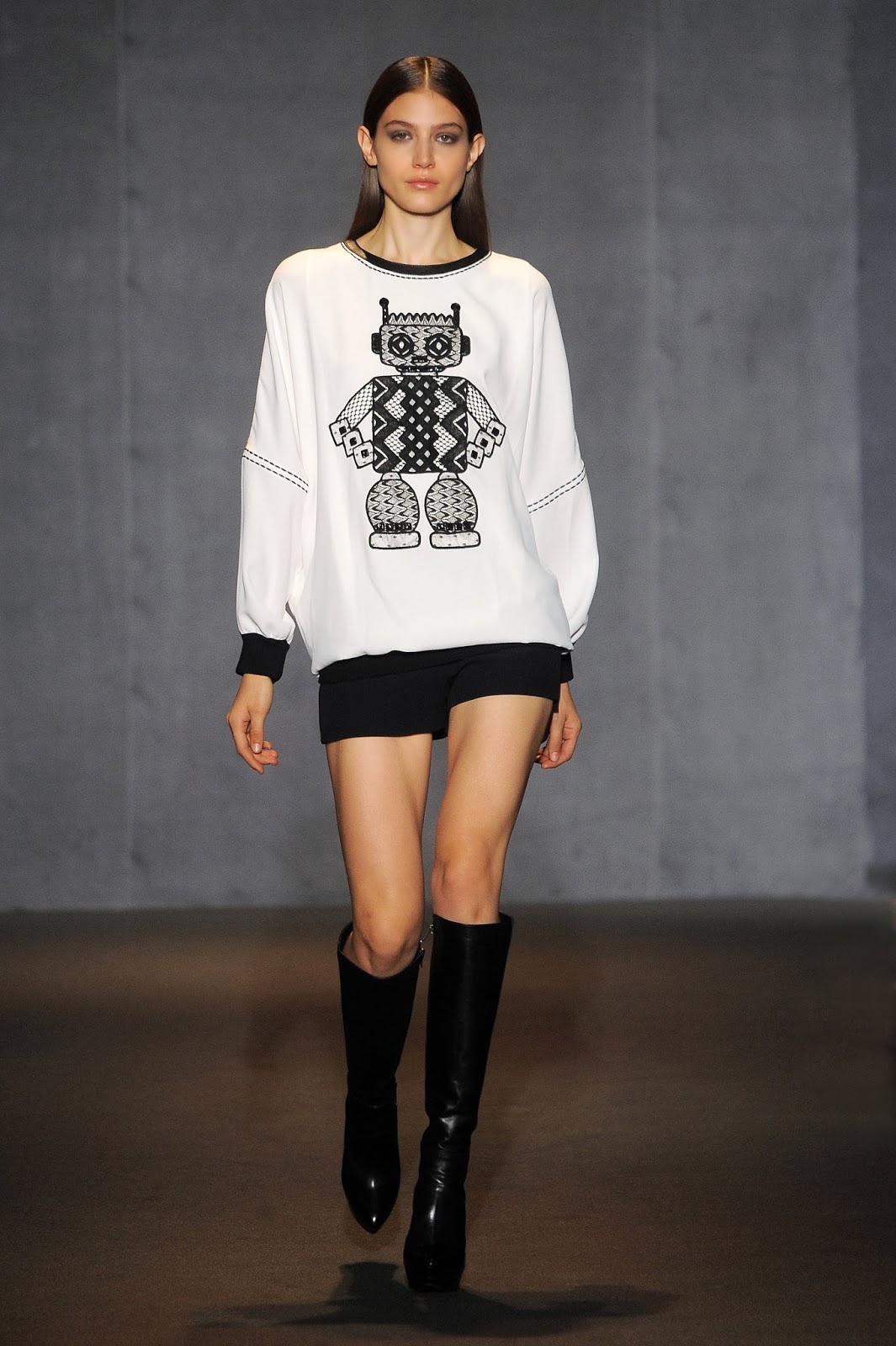
The designer has a thing with robots, and he integrated this interest into his collection. The robots on the blouses and sweaters reminded one of Aztec deities, however.

This mischievousness was in contrast to the glamorous dresses that followed: a strapless gown with green beaded bustier and flowing white mousseline skirt; a sleeveless gown with a blue beaded bodice and black plissé skirt; and a one-shoulder gown with transparent skirt - in unforgettable red.

If there was a drawback to the show, it was the packed seating arrangement and the speed at which the models moved. The two combined caused a few designs to seem rather fleeting, when one wanted to savour Gn’s creativity.

Andrew Gn: walk like a robot.

VIKTOR & ROLF

The quiet yet vibrant elegance at Gn’s show seemed a world away from the clamour of the previous day at the Jardin des Tuileries, where Dutch designers Viktor & Rolf revealed their collection. The Gardens teemed with photographers, dressed-for-effect fans and unwary tourists who must have been wondering what on earth was going on. The feeling was like that of a rock concert.

Viktor & Rolf: shades of grey
The collection itself was in contrast to some of the more flamboyant garments worn by spectators, as Viktor Horsting and Rolf Snoeren went in mostly for grey. Subdued colors were the order of the day, with loose-fitting grey v-neck dresses and sweaters worn with black platform shoes.

The models walked down a grey runway flanked by streetlights, as if on some solitary lane, accompanied by a lone singer and guitar - the American musician Joan As Police Woman. Her “lamentful” version of “Highway to Hell” completely fitted the mood.

Viktor & Rolf did bring on silky browns as well, with splashes of white or silver, and some pastel blues, but the overall effect was of cool, distant glamour. Some of the designs as presented would require courage for any wearer - grey-and-white striped jacket with printed trousers, anyone? -  but they could eventually grow on a lover of ... grey.

Luckily for those who like a bit of colour, especially in grey winter, the designers did show some bright, attractive dresses in salmon, or shall we say, coral shades. Their use of geometric designs and ruffles added interest, but the ubiquitous mixing of leather and fabric might have been avoided.

Besides the clothes, Viktor & Rolf must be praised for their multi-cultural cast of models.  Here, the show was a stand-out. - L. McKenzie & J.M. De Clercq

Viktor & Rolf: coral meets grey
The designers