Friday, February 28, 2014

CAN’T STAND THE RAIN? HEAD FOR MANISH AND GOSIA!

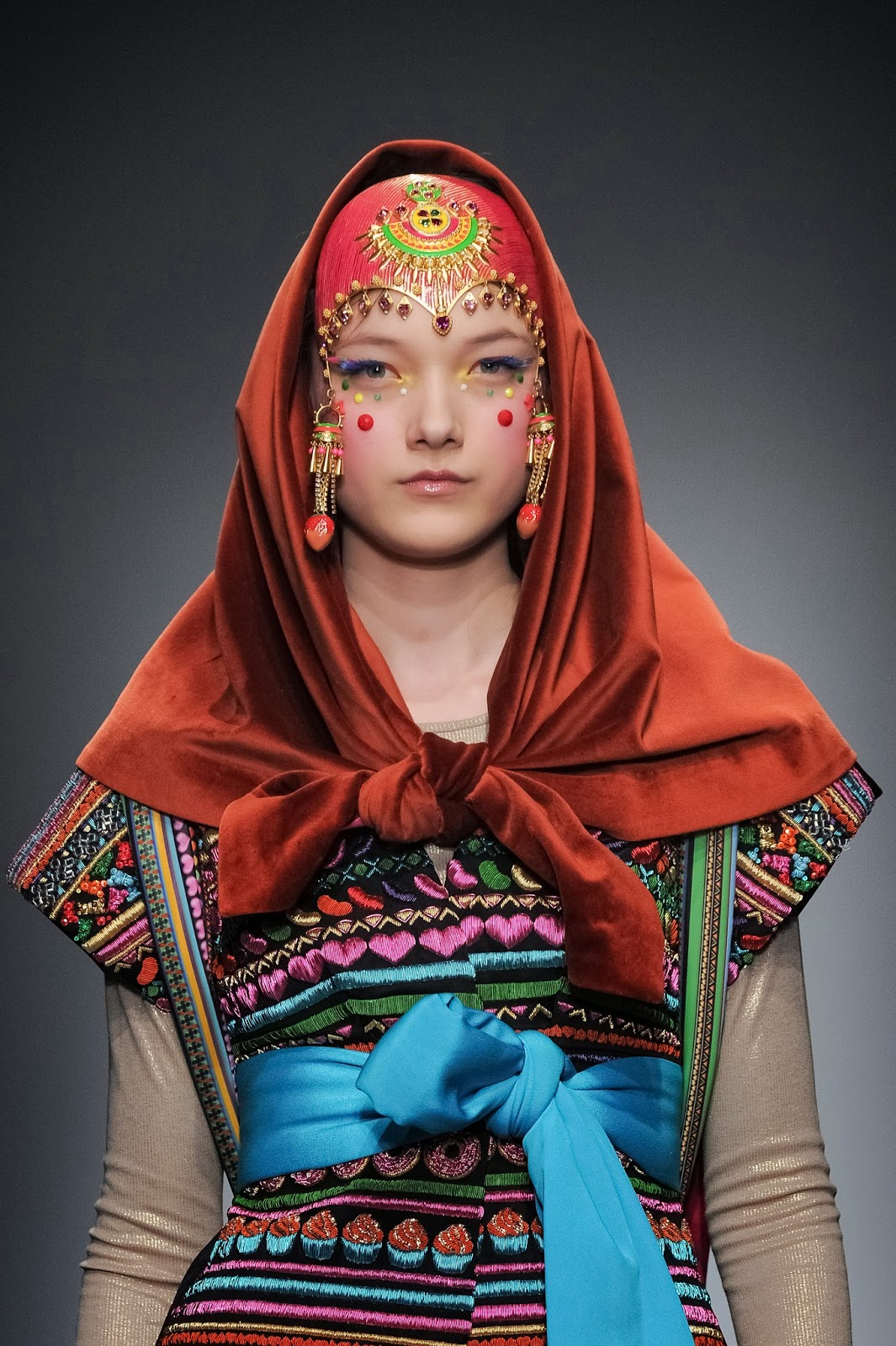
Manish Arora's playful inventiveness. Photo: Yannis Vlamos
The rain and grey weather in France during the first days of Paris Fashion Week were in sharp contrast to the energy and colour of several fashion shows.

Indian designer Manish Arora particularly did much to make one forget the chill winds blowing through the streets of the French capital. Playfulness was the hallmark of his autumn/winter 2014 collection, as he presented a “candy tribe of sweet-toothed nomads and gummy bear gypsies”.

Photo: Yannis Vlamos
The first impression on seeing the designs was: Asia meets South America. Arora showed “oversize ice-cream prints and sugary landscapes” which adorned Peruvian circle skirts and the drop-waisted trousers of ancient Chinese workers, as his house described it.

The models’ steps were lit up by built-in LED lights in their sneakers, while tiny hot water bottles and amusing hip flasks were the accessories to keep Arora’s imaginary travellers warm on their wanderings.

The designer can always be counted on to spring a surprise, and the array of pink, purple, orange and green, together with his traditional embroidery, elicited a certain thrill at his daring. Even without the outlandish pom-poms worn by the models, this would’ve been a show to remember.

GOSIA BACZYNSKA

Photo: Olivier Claisse
In contrast, Polish designer Gosia Baczynska went for the more usual elegance and femininity. The use of lace and cut-outs, with many of the dresses molded to the body, added a sensual element to her collection.

Baczynska has told reporters that it upsets her that fashion is becoming just an industry, and she obviously was motivated to highlight the artistic aspect of fashion design.

She used a range of fabrics, and mixed colours and textures to great effect. This mélange is all the rage at the moment, but not everyone does it well. She can take pleasure in knowing that she does. - J.M. De Clercq and L. McKenzie

Gosia Baczynska shows the art of lace. Photo: Olivier Claisse
            
Arora's perfect coat to brighten a rainy day. Photo: Yannis Vlamos

Tuesday, February 25, 2014

PARIS FASHION WEEK OFF TO SPARKLING, ‘SNOWY’, START

Design by Christine Phung

CHRISTINE PHUNG

The buzz was loud way before Christine Phung’s show Tuesday on the first day of the latest Paris Fashion Week. Couture experts were predicting an innovative autumn/winter 2014-2015 ready-to-wear collection, and Phung did not disappoint.

Phung evokes snow
She told journalists that she created a character around which to base her collection – “that of a girl from a mountain on a dark night, under a canopy of stars”. So it was that the first model who strutted out on the catwalk was dressed in Alpine-type gear, wearing goggles and carrying a pair of skis on her shoulders. The equipment was provided by Rossignol. The clothes were all Phung.

Using cashmere wool, with appliqué patterns, the designer shared her fantasy of this character who “weaves through the trees, cloaked in powdery snow … dazed by her own speed (but) aware of the elements around her – rock, snow, ice, stars, the forest itself”.

It was nearly enough to make one forget that the fashion show was taking place on the second floor of Galeries Lafayette’s “Maison” (home) store, with a wooden runway and wooden benches.  Even if the techno music by Camille Desprès didn’t much bring the mountains to mind, Phung’s designs certainly did.

The vibrantly colored cashmere, digitally printed silk, and woven jacquard were incorporated into sleek cuts, and at times the garments were detailed with crystals and gems to evoke the elements.

Phung's goggles say it all
The materials were meant to symbolize different things: the shimmering gems represented glistening snow, the woven jacquard embodied the snow-covered slopes, and the printed dresses were the “wild flames” of the character’s imagination, according to Phung’s description.

The young French-Cambodian designer also experimented with different colors: blues, maroons, and oranges, along with black and white. The color combinations were striking but did not clash: one design comprised a woolen jacket with blue, grey, maroon and white, worn with orange stockings and simple black heels. Other designs had the more usual hues, and instead emphasized the appealing cut of the clothes.

It was an impressive first day of Paris Fashion Week, with other designers also determined to shine.  

MOON YOUNG HEE

Moon Young Hee's simplicity
Earlier in the day, France-based Korean stylist Moon Young Hee made use of an art gallery on Place des Vosges, in the trendy Marais area of Paris, for her show.

The mood was set with a pared-down remix of Suzanne Vega’s hit “Tom’s Diner”, evocating … well, space and art somehow. As a few spectators tapped their feet, the models emerged, enrobed in thick wools, tulle netting, gauze, and velvets.

The colors were minimalistic: black, white, brown, and blue; the cuts however, were not. Flowing pants, layered coats, and scrunched sleeves. The designs reminded one of Comme des Garçons, but a subdued version.

Each model’s hair was loosely pulled back and tied at the very tip with their own winding strands, which looked effortless yet elegant. The accessories were marginal; the same black creepers on every model, although some of the outfits had accents of crystals.

The collection could be described as slightly gothic, somewhat masculine, and inventively shaped. If some of the models looked pregnant, it was in an entirely fashionable way. - J.M. De Clercq & L. McKenzie


Above: blue dress by Moon Young Hee, and colorful dresses by Christine Phung. (© De Clercq)

Sunday, February 23, 2014

NEW BOOK ILLUSTRATES ART OF FASHION ILLUSTRATORS

Alexandra Compain-Tissier, Bill Cunningham, 2011; Les Inrocks magazine; watercolor

If photography is the “quintessential medium” for portraying the art of fashion, what role does illustration play?

This question, posed by art expert Stephen Heller in his introduction to Ilustration Now! Fashion, is more than adequately answered in the next 400 pages of this bold new book.

Published by TASCHEN, the colourful coffee-table tome shows how art, fashion and journalism fuse in the field of illustration. The book also emphasises that artists, using a variety of media, have a secure position in portraying fashion design - which photography can’t replace.

“Fashion illustration requires the unique ability to wield pen or brush in such a way that it not only captures nuance through gesture but also can readily transform the graphic representation of a garment, accessory or cosmetic into an object of desire,” says Heller.

The 90 illustrators featured in the book do this and more; they display their own artistic talent as well as “interpret” the work of fashion designers. Readers will immediately want to know more about the illustrators as well as the history of their “craft”. The book, edited by the Brazilian-born graphic designer Julius Wiedemann, provides that information as well.

In an in-depth essay that follows the foreword, historian and author Adelheid Rasche traces the evolution of fashion illustration from the 1600s to the present. “It wasn’t until the 17th century that fashion trends began to spread internationally,” Rasche writes. “Because of France’s commercial and cultural supremacy, the nobility and upper middle classes across Europe tried to keep pace with the French royal court.”

Travellers to France were able to gape in person at the luxurious materials around them, while those who were unable to visit the country “had to rely on letters and journalism for information, but above all on visual images”.

These images came via etchings and copper engravings and could be considered as the first fashion illustrations in the early 1600s, according to Rasche. More than a century later, the first fashion magazines “established illustration as a recognized facet of the fashion trade” and two very different styles came into vogue: the flamboyance of Paris and the “simple, rational tastes of the British bourgeoisie”.

Samantha Hahn: Marc Jacobs
NY Fashion Week, Fall 2012
New York magazine/The Cut
The first popular illustrators were from France and Britain, Rasche recounts, but in the 1900s international competition came with the creation of American magazines such as Harper’s Bazaar and Vogue. Some illustrators did enjoy popularity on both sides of the Atlantic, although demand for their work would decline from the 1950s on, as photography gradually took over.

Still, fashion illustration remained “a dynamic means of expression embracing a whole range of artistic styles,” says Rasche. Readers will tend to agree with her assertion that the selections in the book “convincingly demonstrate the sheer creative scope” of the sector.

The illustrators, featured alphabetically, all manage to convey fashion’s “allure” through a variety of techniques, including collage, computer graphics and watercolour. They come from different countries, and work for a range of magazines as well as for famous designers, and the book gives an insight into their creativity.

Istanbul-born Cem Bora, for instance, uses collage to evoke the designs of clients such as Comme des Garçons and Balenciaga, while French illustrator Carlotta utilizes pen, gouache and other media for her economical, cartoon-like sketches. “Fashion is the reflection of life, and for me an illustration can nail an era,” Carlotta says in the book.

Lisa Billvik, Untitled, 2011, Catwalk Studio; pencil  
Some striking images also come from a diverse group of Swedish-born, Stockholm-based artists such as Cecilia Carlstedt, Lina Bodén, Molly Bartling, and especially Lisa Billvik and Maria Raymondsdotter - whose artwork emanates a sense of fun.

Meanwhile, Zé Octavio, Catarina Gushiken and Furia, all from São Paola, Brazil, bring colour and energy to the selections, just like the talented German illustrator Sabine Pieper and the Cuban-born, New-York-based artist Ruben Toledo.

“For me, style is content,” Toledo says. “I let the clothes, the woman, the mood and the style form the composition. Clothing tells a story, and my focus is to listen and communicate that story through art.” - L. McKenzie and J.M. De Clercq

Wednesday, February 12, 2014

FASHION WEEK SPONSOR MAKES DRINK FIT FOR ... A PARISIAN

Fashion fans may find themselves sipping cola instead of champagne at parties during the next Paris Fashion Week, which runs from Feb. 25 to March 5. But it won’t be just any cola as the French capital now has its own caramel-flavoured drink, called – what else – Paris Cola.

The company behind the product, Fonbelle, is a sponsor of Fashion Week and has been heightening its profile recently as it tries to push ahead of other cola contenders and also appeal to civic pride.

Rousseau shows off Paris Cola
“The main thing about Paris Cola is that it’s a local product, made with Parisian water and with locally produced beet sugar,” says Pollyanna Rousseau, Fonbelle’s marketing manager.

The company first developed the product in 2007, but it was only last year that Paris Cola became a viable commercial drink, competing with both international brands as well as a similarly named local beverage.

This year, it has launched a major offensive, with public demonstrations and free tastings in upscale Parisian supermarkets such as the Grande Epicerie.

Rousseau says she wants to position the cola as a drink one wouldn’t feel embarrassed to offer to a dinner hostess, much like a good bottle of wine.

It took eight months to create the right taste, she says, with studies conducted among consumers to make sure the drink wasn’t “too sugary, too caramel or too strong”.

“We wanted the perfect taste for a Parisian, and that was quite difficult,” she adds. “You had to forget about other products and find the taste that you would like to have as a French cola.”

If it's red it must be cola.
After the public testing, the company designed flashy bottles in glass and plastic for retail in French supermarkets such as Auchan and Carrefour, with the product now being available in more than 300 outlets.

“We targeted two kinds of consumers - first young Parisians between the age of 20 and 35 who are willing to try new things, and secondly the tourist market,” Rousseau says.

Fonbelle has long been active in the food-souvenir sector, and the idea is for travellers to have an unusual memento to take back home. The cola, for instance, is sold in glass bottles at stores that tourists frequent, such as the ever-crowded Galeries Lafayette.

The bottle, with a red label, is a deliberate design as consumers seem to identify the colour with colas, perhaps because of a famous international brand.

“When people ask why we’re using red, we explain that the Parisian flag is red,” says Rousseau. “So it makes sense.”

The label also bears images of the Eiffel Tower and two stylish Parisians – a young woman in the iconic “little black dress” and a slender man with an elegant silhouette.

This is meant to evoke the stylishness associated with haute couture and other luxuries, one of the reasons for the link with Fashion Week. Who knows, perhaps consumers will start calling the drink Paris Cola-Champagne. - L. McKenzie & J.M. De Clercq

Tuesday, February 4, 2014

DESIGNING DUO HIT THE ROAD WITH THEIR COOL HOSPITALITY


It wasn’t the kind of scene one expected to come across on a chilly winter evening in Paris. Out in the open, on a cobblestone square near the Marais quarter, several people sat at a long wooden table - eating, drinking and talking animatedly.

Not far from the table, other individuals stirred vegetables and noodles at a stove built on wheels, while one young man popped open bottles of wine.

Passers-by were invited to sit and enjoy the delicious-smelling food, with the guests including a former World Bank official, a well-dressed woman and her daughter, a market vendor, a backpacker, an artist and a journalist.

Getting things ready in Paris.
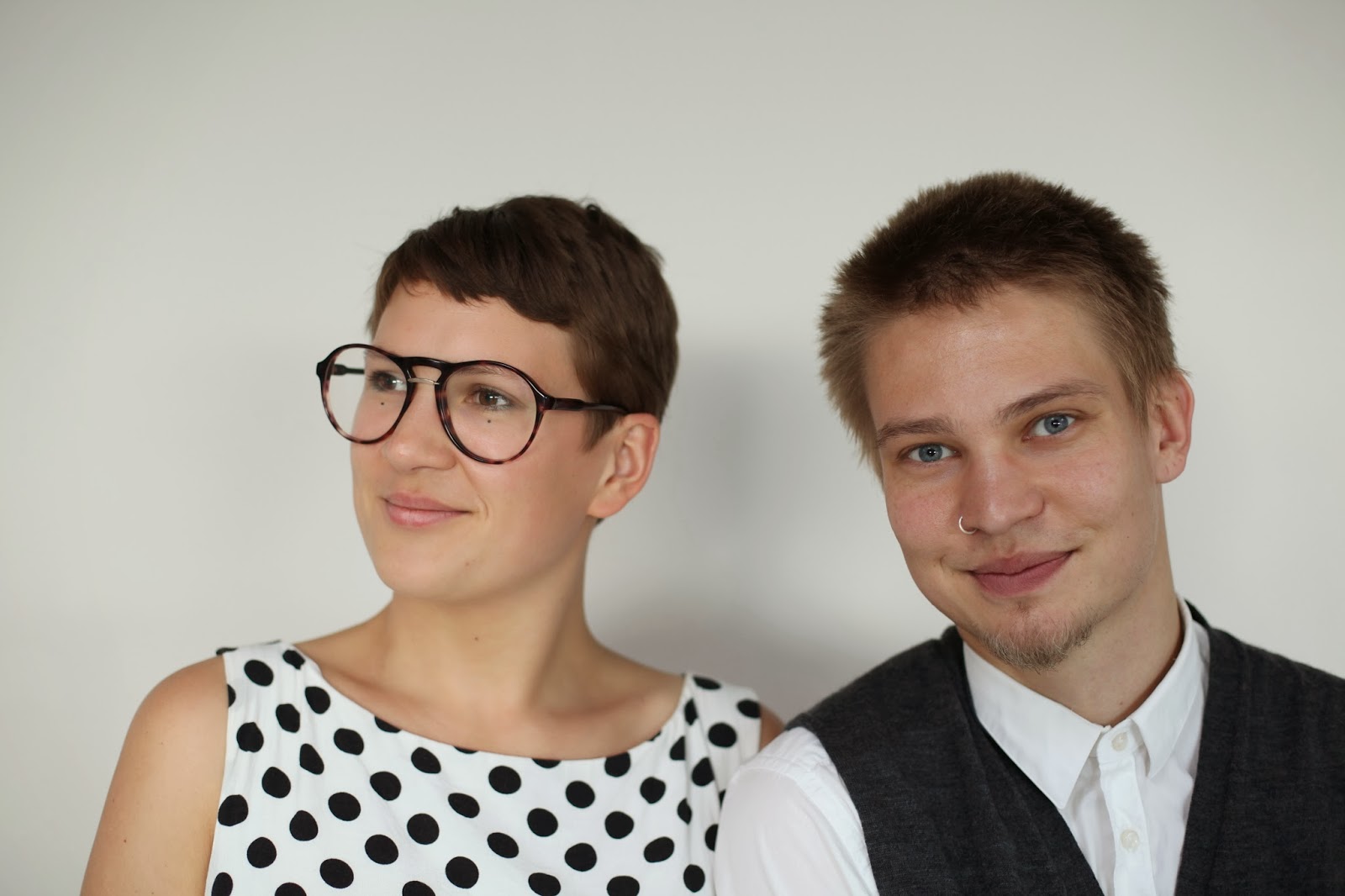
Welcome to “mobile hospitality”, a concept launched by the young Polish furniture designers Ania Rosinke and Maciej Chmara (pictured above) who met when they were both studying architecture and design at the Academy of Fine Arts in Gdansk.

The duo, whose chmara.rosinke company is based in Vienna, Austria, travel with their mobile-modular kitchen and dining table to various cities and invite the public to share free meals. Diners have included both the wealthy and the homeless.

In a couple of months, they hope to take their special brand of hospitality to the United States, offering meals in New York. The aim is not only to showcase their cutting-edge furniture, but also to get strangers talking to one another, they said.

Tasshon interviewed them about the project.

Tasshon: How did it start?
Chmara: We were invited to an art and design fair in Western Austria (ArtDesign Feldkirch), to make an ‘intervention’ in urban space, as we are working between design and art, and the urban space medium interests us very much. We didn’t know this area where we had to do the happening very well, so we decided to get to know the people from the area.

All folded up and ready to cook.
We wanted to make something that would create positive provocation. To get to know people better you have to talk, and the best talking you do is at a table. To keep people at the table you need good food, so the idea was born. We built the first prototype in a friend’s cellar in the Austrian mountains and went on to invite people to eat with us. We always did three dishes so that people had to spend two or three hours while having spontaneous discussions with foreigners.
  
Tasshon: What has the reaction been?
Chmara: The reactions have always been positive; in nearly three years we haven’t had any negative experiences. Sure, sometimes the mix of homeless and more wealthy people can lead to awkward situations, but it has always worked out. People asked us where we would cook over the next days, and they brought us wine, vegetables or homemade marmalade. We still have contact with some guests and several have become friends. It was always difficult to get the first person to sit at our table; once this happened, it didn’t take long until the table was full.
  
Tasshon: Who contributes to the cooking, serving, etc.?
Friends help to peel vegetables in Paris.
Chmara: We were always cooking on our own, and sometimes in galleries we had guest cooks. In Paris it was actually the first time that a cook really worked with us. It has never been difficult to get some sponsorship from an organic vegetable store or some private person or from companies or galleries, because people liked the idea. Sometimes we also paid for the food on our own.

Tasshon: How many cities have been involved?
Chmara: Dornbirn, Feldkirch, Bregenz, Vienna (Austria) Vaduz (Liechtenstein), Bratislava, Berlin, Milan, Paris, Lodz, Gdynia (Poland)… I for sure have forgotten one or two, but I think this was the most. And if it works out and we manage to organize sponsoring, we will go to New York in April and May.
  
Tasshon: Do you have other projects as well?
Chmara: Currently we are working on a bar and restaurant for Caritas (an organization that works with vulnerable people) in Vienna. Cooking as a social phenomenon will also play a big role. Besides that, people with social problems that come to Caritas will build together with us together and learn to construct a big of the furniture we’re making.

Checking the ingredients in an earlier project.
We also want to show that Do-it-yourself projects don’t  have to look “rough and ready“, but that you can build high-quality furniture with not much money. Along the way, we want to teach people and give them something to do.

An important aspect in our work is the relationship of people to the work they do with their own hands, looking at the future, at energy problems. In general, we have to develop craftsmanship and manufacturing more regionally and locally, but to achieve this, our approach to design, to our work and craft has to change. Besides that, we are working on many experimental projects that are not client-based.

Tasshon: What has been the best aspect of the project for you personally?
Chmara: The reaction of homeless people has been very nice. They said that normally there is a kind of soup kitchen at which you have to wait half an hour, and you feel very exposed… nobody talks to you and the food comes without any communication. So, many homeless people don’t go to the soup kitchen as they also want to feel respected. They told us that it was a pleasure to sit at a table together to eat, get to know new people and so on.

(Photos courtesy of the designers.)

Thursday, January 16, 2014

FRENCH ARTIST ANNE ITZYKSON GOES FOR BRONZE

"Youpi!" by Anne Itzykson

The small commune of Le Mée-sur-Seine, south of Paris, is known as a place where the well-heeled like to live. Designer Karl Lagerfeld owned a spacious home there, and members of one royal family are said to have property around the area.

"La Source" by Itzykson
But for art lovers, a trip to Le Mée-sur-Seine is worthwhile for the striking sculpture by French artist Anne Itzykson that graces the roundabout at the junction of several of the commune’s main roads.

Titled “La Source”, the tall nude woman in bronze forms part of a 3-meter high fountain, and was inaugurated in 2008, after three years of work.  It is one of the few public installations that Itzykson has done, and viewing it certainly beats gawking at mere mansions.

Working from her atelier in the 20th district of Paris, Itzykson is among the unusual breed of artists who currently devote themselves to bronze and marble, carrying on the tradition of sculptors such as Auguste Rodin, whom she cites as an inspiration.

When she does group exhibitions, Itzykson’s work stands out both for the artistry and the materials she uses.  At a recent show at Paris’ famed Jardin du Luxembourg, for instance, her sculptures attracted a good deal of attention, offering something different from the customary oils and pastels.

“I love everything about bronze and marble,” she told Tasshon in an interview. “I like the feel, and the look, even when the results can be so completely different.”

Itzykson focuses mostly on the female form but she also does sculptures of children, individually or in groups. She often employs her son and daughter as the models, while the male figures she has created tend to be portrayals of her husband.

 Itzykson in her Paris studio.  McKenzie)
She said that her “passion” for art began when she was 16 years old and saw the poster for an exhibition by Jean-Jacques Pradier - a 19th-century Swiss-born French sculptor who was influenced by classical art.

“The poster showed a close-up of the back of a woman sitting on a velvet cushion, her hair woven in braids,” Itzykson recalled.  “I remember asking my grandmother to take me to see this show although at the time I was not yet interested in sculpture. The softness, femininity and versatility of this marble cushion really struck me.”

As a teenager, Itzykson did not think that art was a career option, so she chose to study marketing, doing a master’s in the United States. While there, she took a pottery course and realized that she had a talent for forming human figures. 

“What truly inspires me the most is the ‘human being’ which I observe everywhere and continuously,” she told Tasshon. “Its expressions intrigue me, not just the faces, but each part of the body: hands, feet. Everything speaks.”

Sculptures by Itzykson
Itzykson worked in marketing for several years before turning fully to art.  It wasn’t an easy path because using bronze and marble is quite a labour-intensive process. 

For bronze, the first step is to create the figure in clay, then to make a mold, which sometimes needs to be in several parts.  Following this, the artist makes a wax replica, completes several other procedures, and finally pours the molten metal. 

The final stages include welding separate pieces of the sculpture together, sanding the object, and colouring the bronze. Having access to a foundry is a must, so one can understand why bronze sculptures often carry a high price tag. And Itzykson’s works are no exception.

Despite the “technical” aspects of producing such sculptures, the artist said that it’s all still an “instinctive" process.  “It’s as if my hands are detached from my mind and searching in the clay for a language to express an idea, a thought,” she explained. “When my pieces are finished, I become the viewer trying to understand and decipher what I meant.”

The limited-edition "Youpi!" series, by Itzykson
She sometimes adds a different material to the bronze, such as crystal. One of her most recent works, “Youpi!”, shows a child with tangled locks sitting on a crystal ball in a pose of joyfulness, arms outstretched. The blend of materials and rich colours are instantly eye-catching, but the process was rather difficult, Itzykson said. And she still has doubts about the finished objects.

“Are my works successful? Who can say? Certainly not me,” she told Tasshon. “It is others who will judge.”

Any visitor to Mée-sur-Seine who drives around her bronze fountain would be quick to reassure her. - L. McKenzie

Tuesday, December 24, 2013

GHENT SHARES ITS SPARKLING SIDE IN WINTER

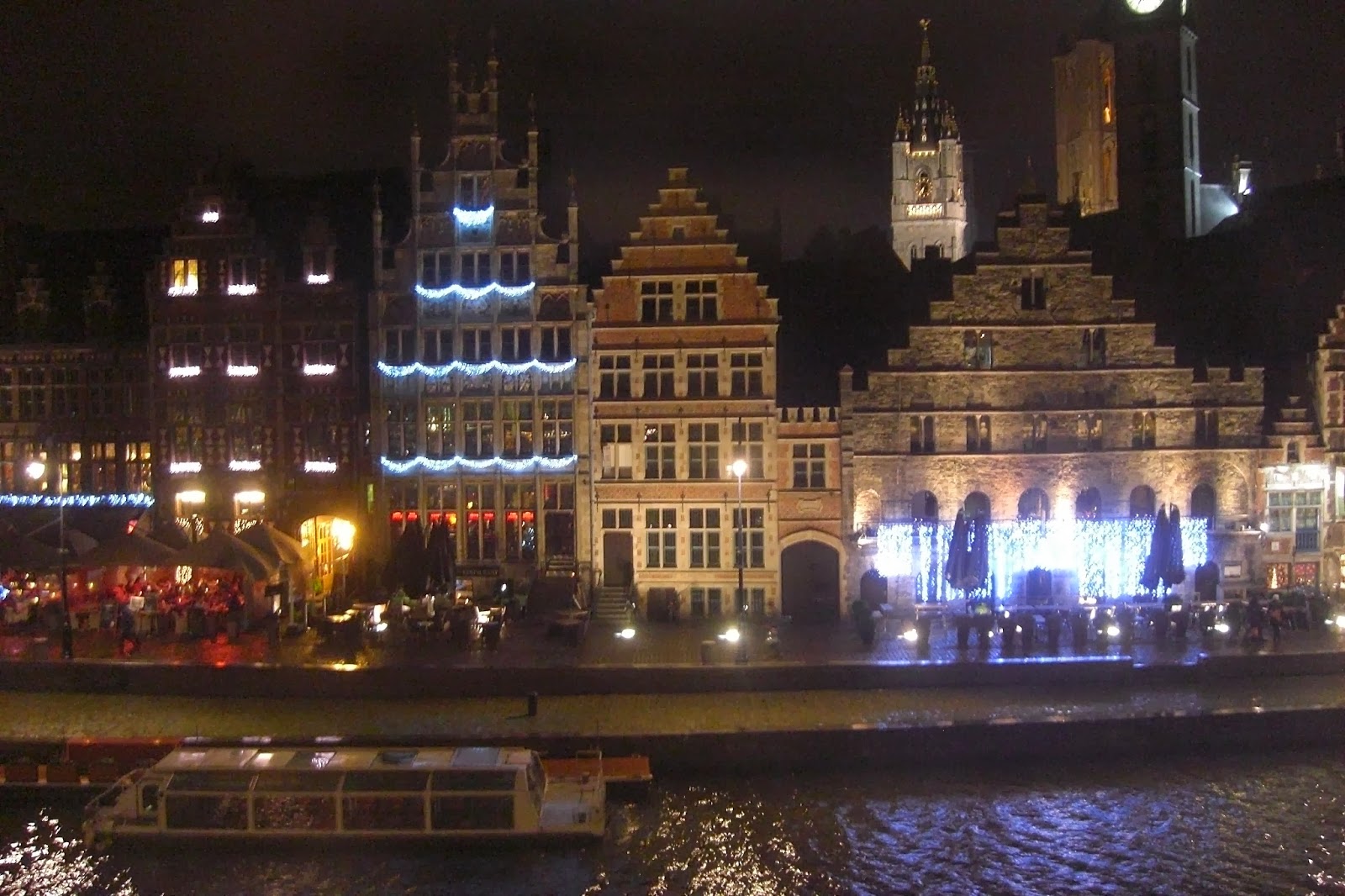
The Graslei at night.
With its film and music festivals, Ghent has become a hip Belgian town to visit during the summer and autumn months. But in winter, this Flemish city has an allure all its own, with festive lights reflecting off the many canals, monuments that one can view without being elbowed by crowds of tourists, and atypical exhibitions mounted just for the season.

The lights around the “three-tower” historical centre are at their most striking in winter, decorating the façade of the medieval buildings on the Graslei, for instance. At night, and especially in the early morning, this old port takes on an added charm, as the colours mirrored in the waters of the Leie make visitors feel like they’re in a famous Flemish painting.

A short distance away, one can find the three buildings that many people travel to Ghent to see: the imposing St Bavo’s Cathedral, the 95-metre-high Belfry with its shiny copper dragon, and the gothic Saint Nicholas Church.

The Cathedral houses many art treasures but is best known for “The Adoration of the Mystic Lamb”, a 12-panel altarpiece (and masterpiece) painted in 1432 by the brothers Hubert and Jan van Eyck. The work features astounding details of religious iconography and tells a multi-faceted story of the birth of Christ.
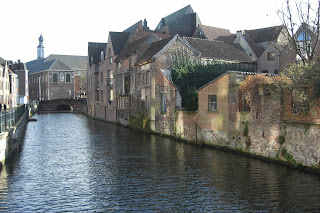
Houses along the Leie
The painting has also seen some turbulent times, having been carted off during various conflicts and even damaged by fire. One panel, “The Just Judges”, is still missing after being stolen in 1934; in its place is a reproduction by another artist.

Ghent town officials launched new restoration work on the altarpiece last September, and this is scheduled to last at least five years. In the meantime, St Bavo’s Cathedral is still displaying two-thirds of the original work, while black-and-white replicas stand in for the panels being restored.

After seeing “The Adoration”, one can climb the stairs to the top of the Belfry for a view of the city that inspired the Van Eycks. The Belfry, one of the tallest bell towers in the world, is a UNESCO World Heritage site, and the dragon on top of the tower is said to be a symbol of “Ghent’s independence”. The dragon has been there since 1380, “watching over the city”, as Ghent experienced invasions, mercantile bustle, rebellions, wars and liberation.

Inside St. Nicholas' Church
From the Belfry, one can admire St. Nicholas’ Church, built in Tournai bluestone in what’s known as the Scheldt Gothic style, named after the region’s Scheldt river. Now considered an architectural gem, particularly because of its grand tower above the crossing of the nave and transept, the church was almost turned into a grain hall during the French Revolution, when all of the city's churches were closed to religious services. Despite being looted, the building survived, however, and has undergone periodic renovation and refurbishing since then.

Down from the Belfry, one can venture inside St. Nicholas’ to hear its organ and see its shiny, elaborate interior after more than 30 years of restoration work.

A different perspective of the city comes from St Michaels Bridge (Sint Michielshelling) with the river stretching in both directions and the three towers of the city lined up as if for the perfect photo.  Then it’s time to explore Ghent’s quirky medieval streets, calm and quiet in winter.

Like most of Belgium, the city gets its fair share of rain. Yet, when one least expects it, there will be a sun-filled day, with the light glinting off the tops of the gable roofs and being reflected in the water of the city’s myriad canals. 

The Castle of the Counts
The streets north of the Graslei lead to the daunting Castle of the Counts (Gravensteen), where one can view dungeons and a torture museum, or just imagine time-travelling back to the 12th century when the castle was built by  Philip I, Count of Flanders. In winter, with the early falling of dusk, the castle seems even more imposing than in the summer months when the daylight lasts until late evening.

Ghent is also the birthplace of Charles V, Holy Roman Emperor, who was born there in 1500. His statue can be found a few streets away from the Gravensteen, on the Prinsenhof Plein. He seems to have had surprisingly short legs.

He would probably have ridden through the Patershol, the medieval centre of Ghent, with its narrow well-preserved houses along the cobblestone streets. One can now rent a bike (no horses) from the Tourist Office, but the buildings are best admired as one strolls leisurely through the area, remembering to speak in a low voice. Many of the houses bear signs asking visitors to be quiet because “the residents are sleeping”. Revelers during the summer no doubt create quite a ruckus.

The Graslei in the early morning.
The visitors expected for January’s Ghent Light Festival should be less noisy, as only sounds of awe tend to accompany the sight of the city being made into "a living light exhibition”, as the organizers describe it.

Last year the Festival simulated the burning of the Belfry, through the play of lights, and in January 2015, for the third edition of the festival, visitors can expect to feel the same kind of childish excitement brought on by a good fireworks show, as "artistic illumination" makes Ghent sparkle. - L. McKenzie & J.M. De Clercq