Friday, October 21, 2016

FIAC CONTEMPORARY ART FAIR BRINGS BACK THE SUN, AND FUN

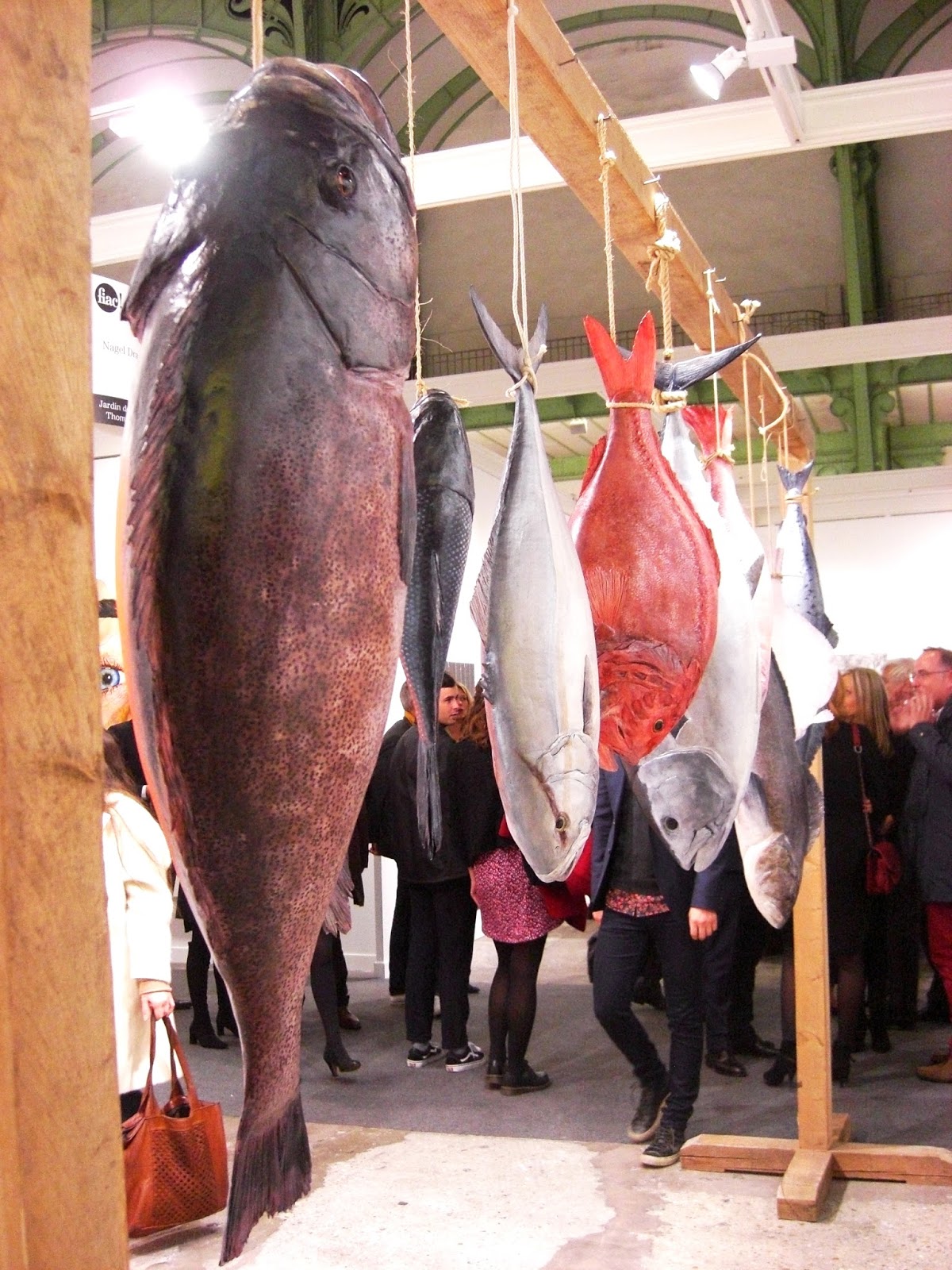
The Fisheries, by artist Mark Dion, displayed at FIAC.

A great way to escape the autumn greyness in Paris is to surround oneself with the colour and gaiety (some would say absurdity) of the annual International Contemporary Art Fair (FIAC), and this year, there is enough brightness to last for weeks.

Running from Oct. 20 to 23 in the French capital, the fair has brought together 186 galleries from 27 countries for its 43rd edition, and it has expanded from its historical venue – the Grand Palais – to the twin building across the street, the Petit Palais, with a series of sculptures and installations.

Colored Vases by Ai Weiwei.
Both buildings were constructed for the 1900 Exposition Universelle (World’s Fair) and designed by the same architect, Charles Girault, so FIAC’s expansion is reviving “the historical unity” of these two landmarks, says the fair’s director Jennifer Flay. 

The On Site part of FIAC at the Petit Palais makes the most of the building’s gallery, pavilion, garden and esplanade to present playful and memorable artwork, “entering into conversation with the permanent collection”, Flay adds.

In the Grand Palais meanwhile, exuberance fills the vast space, as the various galleries show their most striking and off-beat works. The Fisheries by American artist Mark Dion drew visitors to the Nagel Draxler Gallery stand on opening night, many taking photos of the multi-hued “fish” hanging from a horizontal pole.

Viewing Piangiamore's artwork.
But nearly every gallery at the fair has presented a talking point, whether from renowned or upcoming artists. Eye-catching vases by Chinese master Ai Weiwei are on display at Lisson Gallery, while around the corner, Rome’s Magazzino Gallery exhibits the weighty works of the Italian Alessandro Piangiamore.

Piangiamore collects all kinds of flowers, arranges them on a background and then covers them with plaster and bits of iron, not knowing what the result will be.

Viewers of the artwork can see the outline of the flowers and their colours, trying to break free from the plaster. The lightness of the blooms get weighed down by the other materials, and each piece requires quite a bit of muscle to lift it.

“No, no, they’re not heavy,” said a gallery representative on opening night, raising one a few centimetres from the floor. But they are, for the average art-lover – heavy and intriguing.

Schifano's Giallo.
“Lightness” at the gallery comes in the form of the bright-yellow, monochromatic painting of Mario Schifano. He creates textures by first putting broad swathes of paper on canvas, and then painting over them. So, it’s not just a square of yellow that one is looking at, even if the work is titled simply Giallo.

At several other galleries, monochromes are also a feature, with red and orange being the colours of choice. The effect is that when one leaves the fair, it’s as if one takes the sun outside to the drizzly fall weather. - Text and photos by Tasshon


A sunny welcome at FIAC 2016?

Saturday, October 15, 2016

PARIS PRESENTS A SWEEPING EXHIBITION OF MEXICO'S ARTISTS

It's apparently been at least 50 years since the public was treated to such a feast of Mexican art, but many will agree that the new show at the Grand Palais in Paris has been worth the wait.

The poster for the exhibition.
 Courtesy of Rmn-Grand Palais
Titled Mexique 1900 - 1950: Diego Rivera, Frida Kahlo, José Orozco and the avant-garde, the exhibition gives a wide-ranging view of Mexico’s best known artists as well as numerous others, placing them in a historical overview.

According to curator Agustin Arteaga Dominguez, the exhibition (which started earlier this month) offers a “fresh new look” at the “limitless Mexican art scene” of the first half of the 20th century.

More than 200 works fill two floors of the Grand Palais, tracing “a vast panorama across modern Mexico, from the first stirrings of the Revolution to the middle of the 20th century, complemented by a number of works from contemporary artists”.

This is a period particularly known for the Mexican School of Painting and its most prominent movement, Muralism. The French and Mexican co-organizers have thus given pride of place to the imposing works of “los Tres Grandes” (the Three Greats), as the most influential muralists were called: José Clemente Orozco, David Alfaro Siqueiros and Diego Rivera.

Frida Kahlo's The Two Fridas, 1939,
Collection Museo de Arte Moderno, Mexico
Their work defined the era following the Mexican Revolution of 1910-1920, and many of the paintings have become iconic. 

But the show spotlights other major artists, with a section, for instance, on “strong women” – where Frieda Kahlo is naturally the star. Her paintings here include the captivating “Self Portrait with Cropped Hair” and “The Two Fridas”, presented in a kind of conversation with the works of fellow artists such as Nahui Olin and Rosa Rolanda.

Overall, the exhibition is so impressively ambitious in scope that it’s hard to take in everything. Still, even if viewers see only a couple of murals by Rivera and Orozco, and one or two paintings by Kahlo, the trip will have been worth it. - Tasshon

"Mexique 1900 - 1950: Diego Rivera, Frida Kahlo, José Orozco and the avant-garde" is on at the Grand Palais in Paris until Jan. 23, 2017. It's co-organized by France’s Réunion des  musées nationaux-Grand Palais and Mexico’s Secretaría de Cultura, Instituto Nacional de Bellas Artes, Museo Nacional de Arte. 

Saturday, October 8, 2016

FASHION WEEK: EMERGING DESIGNERS PUSH STYLE FORWARD

Apart from the high-profile armed robbery that everyone has now heard about, the latest Paris Fashion Week mostly escaped the circus-like ambiance of former seasons.

This quieter atmosphere enabled a greater spotlight on notable showroom events, such as Fashion Forward Dubai (FFWD), a Middle Eastern platform that made its debut in Paris this year, running from Sept. 30 to Oct 5 and attracting fashion buyers and prospective fans.

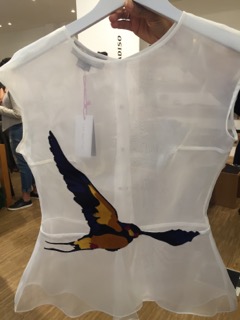
Design by Zena Presley (photo: Coste)
Held in the popular Marais district, the presentation showcased a “carefully curated selection” of apparel and accessory designers who included Amira Haroon, Bedouin, Bil Arabi, Hâshé, Kage, Madiso, Maram, NS By Noof, Orkalia, Rula Galayini, Salta and Zena Presley.

Their designs comprised clothing, jewelry, handbags and other accessories, most of which stood out for the exceptional fabrics and other materials used.

Syrian-born, Dubai-based designer Presley, for instance, displayed delicate dresses with tailored cuts for her spring / summer 2017 collection.

Meanwhile, Bil Arabi's Nadine Kanso – who was born in Lebanon and is also based in Dubai – showed her unique rings, earrings and bracelets, which she said are based on her handwriting. This was her second show in Paris.

Ava Hashemi, the creative director of Hâshé, said that the region has a new generation of designers who are forging new directions in fashion, drawing upon their multi-cultural heritage for their singular creations.

Originally from Iran, Hashem was raised in the United Arab Emirates, and her work is “fueled by Middle Eastern culture, architecture, art and environment,” according to the company. Her ready-to-wear line blends a modern flair with traditional elegance.

Jewelry from  Bil Arabi (photo: Coste)
The FFWD, launched three years ago, has now showcased seven events, twice per year, gaining recognition in the style world. It will enter its eighth season on Oct. 20 in Dubai, presenting ready-to-wear, couture and accessory designers in the Middle East and North Africa (MENA) region over four days.

Endorsed by the Dubai Design and Fashion Council (DDFC) and supported by strategic partner Dubai Design District (d3), the platform in August 2016 launched an empowerment program called EPIC (Empowerment Program through Industry Collaboration).

This is sponsored by the company Samsung Electronics Mena, and it aims to provide business development opportunities to regional fashion talent through a series of initiatives, a spokesperson stated. - Tasshon

Monday, October 3, 2016

FASHION WEEK: FORGET ROBBERIES, THINK DORHOUT MEES

Dorhout Mees: putting together unlikely hues for an "electric" look.

In the middle of Paris Fashion Week, the news suddenly switched from the designs to the robbery at gunpoint of American celebrity Kim Kardashian.

But as sad and shocking as the theft of million-dollar jewelry might be, another newsworthy event was the scintillating collection that Dutch designer Dorhout Mees presented that same night, Oct. 2.

Bold, inspiring and supremely daring, her Spring/Summer 2017 Ready-to-Wear collection mixed unlikely colours and combinations for a show that was modern yet full of mystery.

Dorhout Mees: when lightning strikes.
Titled Orphic, the designs were inspired by the “striking of lightning in nature, but also the fascination of what happens when lightning strikes a person, who survives”, said stylist Esther Louise Dorhout Mees, who founded the brand in 2010.

The show began with a film portraying images of trees, streams, waterfalls – while the models emerged as dark silhouettes. As they stood in front of the movie screen, facing the audience, flashes of simulated lightning struck their bodies, illuminating the clothing. Then they strode down the runway, on chunky heels or leather sneakers, followed by the light.

The hues used for the designs evoked electricity, which was entirely Mees’ aim. Her palette included silver, sheer white, teal, roseate and ruby; she paired pale green trousers with off-the-shoulder pink tops, for instance, and the models' pastel-coloured sneakers had scarlet laces, attracting the eyes as if to a dancer's feet.

According to the show’s notes, a “sliver of silver lying on the body as a shiny metallic second skin, showing each joint,” was the result of electricity being put through the material “to make it react in these rainbow-like patches”.

Dorhout Mees: ruby and transparency.
But stronger colours such as scarlet and burgundy also featured in playful gowns and cocktail dresses, as well as in shorts and flowing trousers that incorporated transparent material for a striking look.

"The combination of something that is so beautiful to behold and at the same time so dangerous was so interesting to me, the fragility of a material or our own body in that way for me was such an interesting thought … that it created my whole collection,” said the designer.

Mees received loud cheers from the thrilled audience, as the show ended with the models grouped together for a silent moment in the twilight, and she later celebrated backstage with her bevy of enthusiastic assistants. - De Clercq / McKenzie (Tasshon)

Dorhout Mees: mixing it up.
Designer Dorhout Mees: emerging from the trees.

Saturday, September 24, 2016

SCULPTOR ALEXANDER POLZIN AND THE ART OF RESPONSIBILITY

Was bleibet aber, stiften die Dichter.  And poets establish / that which endures.

So do artists such as Alexander Polzin, who uses this quote from the Romantic poet Friedrich Hölderlin for the title of a new exhibition, running until Nov. 5 at Galerie Kornfeld in Berlin, Germany.

The show follows the inauguration of a poignant sculpture that Polzin erected in Paris earlier this year – in honour of the German Jewish poet Paul Celan, who lived and died in France after escaping the horrors of World War II, in which his parents were killed.

German artist Alexander Polzin
Polzin said he had dreamt for 17 years of creating a monument in memory of Celan, to be placed in the latter’s adopted city of Paris, and that dream became a reality in May when the sculpture Hommage à Paul Celan was unveiled during a ceremony at the city’s Anne Frank Garden.

To celebrate Polzin's Hommage, Galerie Kornfeld is now showing a selection of the artist’s sculptures, paintings and works on paper, all of which explore the art of poetry and its authors.

“This intensive exploration of literary and philosophical texts and ideas forms the essence of Alexander Polzin’s work,” the Gallery says. “The artist has close personal and intellectual ties with many writers, philosophers and scientists.”

In addition to the draft for Monument for Paul Celan, the exhibition assembles works inspired by the words and personalities of writers as varied as Dante Alighieri, Giordano Bruno, Bertolt Brecht, Heiner Müller and Thomas Brasch.

Although the human figure is at the centre of his sculptural work, Polzin is not interested in a “portrait-like reproduction of people” but is mostly concerned “with the ideas that take shape in his art”, the Gallery adds.

Maquette section: Monument to Paul Celan,
by artist Alexander Polzin
Central themes concern moral, social and societal questions.  During a well-attended talk in Paris (organized by the Arts Arena and held at the city’s branch of Columbia Global Centers), Polzin told listeners that he very consciously seeks out the public space as a stage, where art can create dialogue and a different way of thinking.

In an interview after his presentation, he said that the artist has certain responsibilities, which for him are of paramount importance.

“I feel responsibility for the past and for the future, because I want to help to make sure that some things never happen again,” Polzin said. “I don’t consider myself an activist, yet everything I do is political. But that’s automatic.

“I think that if you do your work as an artist, in a way that’s truthful to yourself and to your art, then it comes automatically that you’re doing something for the good of society. Just like a baker needs to make good bread,” he continued.

Polzin's Hommage monument in Paris.
Born in East Berlin, Polzin trained as a stonemason in his youth. While sculpture remains his primary means of expression, his work includes paintings, drawings, graphics, and directorial projects.

In addition to the Hommage à Paul Celan artwork in the Anne Frank Garden and the sculpture The Pair in the foyer of Paris’ Opéra National de la Bastille, the public can see his striking Giordano Bruno monument on Potsdamer Platz in Berlin, and the sculpture Socrates on the campus of Tel Aviv University.

Polzin’s works have also been exhibited in international galleries and museums, such as the Getty Center in Los Angeles, the Anna Achmatova Museum in St. Petersburg, the Kunstmuseum Ahrenshoop and, most recently, in the museums of the Vatican in Rome, the Gallery says. - Tasshon

Wednesday, September 21, 2016

FRENCH MUSEUM SPOTLIGHTS WOMEN ARTISTS AND MODELS

Not much attention has been given to the representation of women, both as artists and models, during the second half of the 19th century and the beginning of the 20th, but an exhibition taking place in Poitiers, France, aims to rectify this oversight.

Tamara de Lempicka
 Kizette en Rose 1927
Coll. Musee des Beaux Arts de Nantes
©RMN-Grand Palais / Gerard Blot
 ©Tamara Art Heritage/ADAGP
Running until Oct. 9, Belles de jour: femmes artistes, femmes modèles (Beauties of the Day: Women Artists, Women Models”) shows a view of women in “full evolution”, according to the curator.

The artworks go from exalting women’s beauty, to a portrayal that’s more modern and natural. (The exhibition's title is a take on the 1928 novel by Joseph Kessel, which was made into a film in 1967, starring French actress Catherine Deneuve. Many of Deneuve's costumes were created by Yves Saint Laurent.)

“Women have always influenced art,” says curator Raphaële Martin Pigalle. “Personalities such as designer Coco Chanel, for instance, led to certain representations. But we’re also looking at women artists, many of whom don’t get the attention that they merit, and at male artists who used the feminine presence to convey certain things.”

The exhibition includes works by Tamara de Lempicka, Kees Van Dongen, Félix Vallotton, Suzanne Valadon, Sigmar Polke, Camille Claudel and many other artists of the time.

From courtesans to muse to mothers, the characters depicted show women’s historical roles as well as the artists’ imaginings of them. Women are seen as a “symbol of truth, of fantasy and of freedom,” says the curator.

She adds that the show is aimed at starting a “dialogue” between viewers and the works, and also at examining gender inequities in the art world. Women were not allowed to be students at Paris’ prestigious Ecole des Beaux Arts until 1897, for example.

The exhibition takes place at Poitier’s Musée Sainte-Croix, in partnership with the Musée des Beaux-Arts de Nantes and the Palais Lumière d’Évian. Located in a historic neighbourhood, the Musée Sainte-Croix was built by architect Jean Monge en 1974, and last year was awarded a heritage label (“Patrimoine du XXe siècle”).  

Thursday, September 8, 2016

CHINA TRAVEL: CATCHING SIGHT OF WORLD HERITAGE SITES

A courtyard in Pingyao Ancient City, a UNESCO World Heritage Site.

It’s probably not common knowledge that China has 48 UNESCO World Heritage Sites, ranging from the Great Wall in Beijing – naturally – to the quaint historic town of Pingyao, which has its own well-preserved fortification.

The Terracotta Army, in Xi'an
Visiting these sites will enrich any trip to the country, as they provide not only impressive views but also a journey through hundreds of years of history.  The Mausoleum of the first Qin Emperor, with the legendary Terracotta Army, will probably be one of the most memorable artefacts any traveller will ever see.

Located in Xi’an, the Terracotta Army was discovered in 1974 by farmers in the region and became a UNESCO World Heritage site in 1987. Here visitors can see rows of terracotta sculptures, dating from the third century BC and representing the armies of China’s first emperor, Qin Shi Huang. The sheer number and intricacy of the sculptures – known as burial or funerary art – make for an awe-inspiring vista.

On the Wall of Xi'an
But this is not the only attraction in Xi’an. The city also has a wall, where one can walk or cycle and view from on high both the old town and the expanding modern landscape. As with most urban areas in China, the ancient sits right alongside the new, and moving from traditional neighbourhoods to gleaming new skyscrapers can seem like a kind of time travel.

Xi’an is known as well for its ethnically diverse neighbourhoods, where tourists throng the streets to sample the special cuisine. Flatbread, stews and grilled meat are just some of the offerings, both from sidewalk stalls and brightly lit restaurants. 

Exploring this city and others was the high point of a two-month trip to China - travelling from Beijing to Shenzhen. It included several World Heritage Sites on the way, along with memorable meals and interactions with friendly people. 

A food stall in Xi'an 
The Wulingyuan Scenic Area, a UNESCO World Heritage Site
in Zhangjiajie. The mountains inspired a part of the setting
for the movie Avatar.

In Fenghuang, a town on the water.