Tuesday, February 4, 2014

DESIGNING DUO HIT THE ROAD WITH THEIR COOL HOSPITALITY


It wasn’t the kind of scene one expected to come across on a chilly winter evening in Paris. Out in the open, on a cobblestone square near the Marais quarter, several people sat at a long wooden table - eating, drinking and talking animatedly.

Not far from the table, other individuals stirred vegetables and noodles at a stove built on wheels, while one young man popped open bottles of wine.

Passers-by were invited to sit and enjoy the delicious-smelling food, with the guests including a former World Bank official, a well-dressed woman and her daughter, a market vendor, a backpacker, an artist and a journalist.

Getting things ready in Paris.
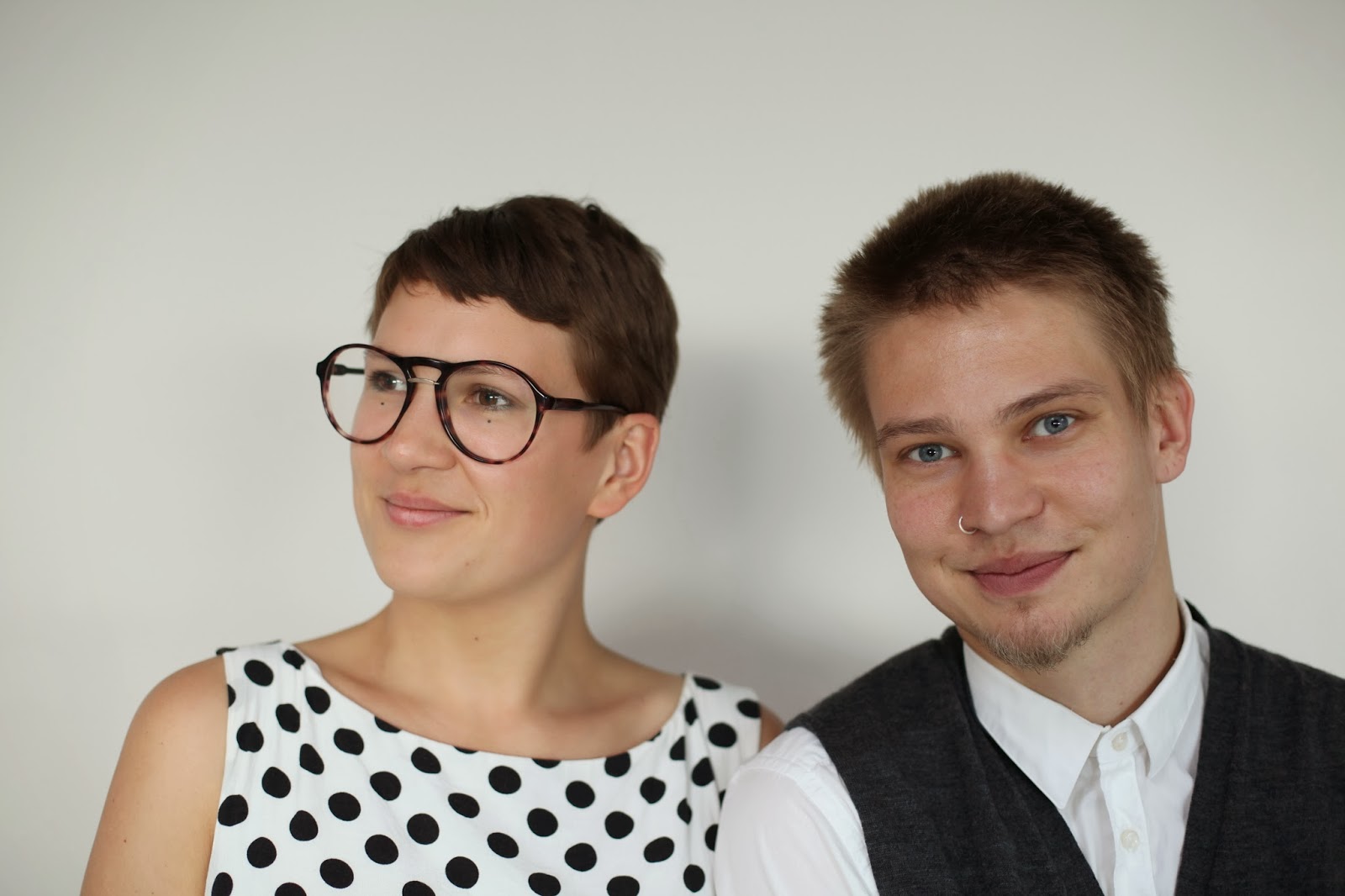
Welcome to “mobile hospitality”, a concept launched by the young Polish furniture designers Ania Rosinke and Maciej Chmara (pictured above) who met when they were both studying architecture and design at the Academy of Fine Arts in Gdansk.

The duo, whose chmara.rosinke company is based in Vienna, Austria, travel with their mobile-modular kitchen and dining table to various cities and invite the public to share free meals. Diners have included both the wealthy and the homeless.

In a couple of months, they hope to take their special brand of hospitality to the United States, offering meals in New York. The aim is not only to showcase their cutting-edge furniture, but also to get strangers talking to one another, they said.

Tasshon interviewed them about the project.

Tasshon: How did it start?
Chmara: We were invited to an art and design fair in Western Austria (ArtDesign Feldkirch), to make an ‘intervention’ in urban space, as we are working between design and art, and the urban space medium interests us very much. We didn’t know this area where we had to do the happening very well, so we decided to get to know the people from the area.

All folded up and ready to cook.
We wanted to make something that would create positive provocation. To get to know people better you have to talk, and the best talking you do is at a table. To keep people at the table you need good food, so the idea was born. We built the first prototype in a friend’s cellar in the Austrian mountains and went on to invite people to eat with us. We always did three dishes so that people had to spend two or three hours while having spontaneous discussions with foreigners.
  
Tasshon: What has the reaction been?
Chmara: The reactions have always been positive; in nearly three years we haven’t had any negative experiences. Sure, sometimes the mix of homeless and more wealthy people can lead to awkward situations, but it has always worked out. People asked us where we would cook over the next days, and they brought us wine, vegetables or homemade marmalade. We still have contact with some guests and several have become friends. It was always difficult to get the first person to sit at our table; once this happened, it didn’t take long until the table was full.
  
Tasshon: Who contributes to the cooking, serving, etc.?
Friends help to peel vegetables in Paris.
Chmara: We were always cooking on our own, and sometimes in galleries we had guest cooks. In Paris it was actually the first time that a cook really worked with us. It has never been difficult to get some sponsorship from an organic vegetable store or some private person or from companies or galleries, because people liked the idea. Sometimes we also paid for the food on our own.

Tasshon: How many cities have been involved?
Chmara: Dornbirn, Feldkirch, Bregenz, Vienna (Austria) Vaduz (Liechtenstein), Bratislava, Berlin, Milan, Paris, Lodz, Gdynia (Poland)… I for sure have forgotten one or two, but I think this was the most. And if it works out and we manage to organize sponsoring, we will go to New York in April and May.
  
Tasshon: Do you have other projects as well?
Chmara: Currently we are working on a bar and restaurant for Caritas (an organization that works with vulnerable people) in Vienna. Cooking as a social phenomenon will also play a big role. Besides that, people with social problems that come to Caritas will build together with us together and learn to construct a big of the furniture we’re making.

Checking the ingredients in an earlier project.
We also want to show that Do-it-yourself projects don’t  have to look “rough and ready“, but that you can build high-quality furniture with not much money. Along the way, we want to teach people and give them something to do.

An important aspect in our work is the relationship of people to the work they do with their own hands, looking at the future, at energy problems. In general, we have to develop craftsmanship and manufacturing more regionally and locally, but to achieve this, our approach to design, to our work and craft has to change. Besides that, we are working on many experimental projects that are not client-based.

Tasshon: What has been the best aspect of the project for you personally?
Chmara: The reaction of homeless people has been very nice. They said that normally there is a kind of soup kitchen at which you have to wait half an hour, and you feel very exposed… nobody talks to you and the food comes without any communication. So, many homeless people don’t go to the soup kitchen as they also want to feel respected. They told us that it was a pleasure to sit at a table together to eat, get to know new people and so on.

(Photos courtesy of the designers.)

Thursday, January 16, 2014

FRENCH ARTIST ANNE ITZYKSON GOES FOR BRONZE

"Youpi!" by Anne Itzykson

The small commune of Le Mée-sur-Seine, south of Paris, is known as a place where the well-heeled like to live. Designer Karl Lagerfeld owned a spacious home there, and members of one royal family are said to have property around the area.

"La Source" by Itzykson
But for art lovers, a trip to Le Mée-sur-Seine is worthwhile for the striking sculpture by French artist Anne Itzykson that graces the roundabout at the junction of several of the commune’s main roads.

Titled “La Source”, the tall nude woman in bronze forms part of a 3-meter high fountain, and was inaugurated in 2008, after three years of work.  It is one of the few public installations that Itzykson has done, and viewing it certainly beats gawking at mere mansions.

Working from her atelier in the 20th district of Paris, Itzykson is among the unusual breed of artists who currently devote themselves to bronze and marble, carrying on the tradition of sculptors such as Auguste Rodin, whom she cites as an inspiration.

When she does group exhibitions, Itzykson’s work stands out both for the artistry and the materials she uses.  At a recent show at Paris’ famed Jardin du Luxembourg, for instance, her sculptures attracted a good deal of attention, offering something different from the customary oils and pastels.

“I love everything about bronze and marble,” she told Tasshon in an interview. “I like the feel, and the look, even when the results can be so completely different.”

Itzykson focuses mostly on the female form but she also does sculptures of children, individually or in groups. She often employs her son and daughter as the models, while the male figures she has created tend to be portrayals of her husband.

 Itzykson in her Paris studio.  McKenzie)
She said that her “passion” for art began when she was 16 years old and saw the poster for an exhibition by Jean-Jacques Pradier - a 19th-century Swiss-born French sculptor who was influenced by classical art.

“The poster showed a close-up of the back of a woman sitting on a velvet cushion, her hair woven in braids,” Itzykson recalled.  “I remember asking my grandmother to take me to see this show although at the time I was not yet interested in sculpture. The softness, femininity and versatility of this marble cushion really struck me.”

As a teenager, Itzykson did not think that art was a career option, so she chose to study marketing, doing a master’s in the United States. While there, she took a pottery course and realized that she had a talent for forming human figures. 

“What truly inspires me the most is the ‘human being’ which I observe everywhere and continuously,” she told Tasshon. “Its expressions intrigue me, not just the faces, but each part of the body: hands, feet. Everything speaks.”

Sculptures by Itzykson
Itzykson worked in marketing for several years before turning fully to art.  It wasn’t an easy path because using bronze and marble is quite a labour-intensive process. 

For bronze, the first step is to create the figure in clay, then to make a mold, which sometimes needs to be in several parts.  Following this, the artist makes a wax replica, completes several other procedures, and finally pours the molten metal. 

The final stages include welding separate pieces of the sculpture together, sanding the object, and colouring the bronze. Having access to a foundry is a must, so one can understand why bronze sculptures often carry a high price tag. And Itzykson’s works are no exception.

Despite the “technical” aspects of producing such sculptures, the artist said that it’s all still an “instinctive" process.  “It’s as if my hands are detached from my mind and searching in the clay for a language to express an idea, a thought,” she explained. “When my pieces are finished, I become the viewer trying to understand and decipher what I meant.”

The limited-edition "Youpi!" series, by Itzykson
She sometimes adds a different material to the bronze, such as crystal. One of her most recent works, “Youpi!”, shows a child with tangled locks sitting on a crystal ball in a pose of joyfulness, arms outstretched. The blend of materials and rich colours are instantly eye-catching, but the process was rather difficult, Itzykson said. And she still has doubts about the finished objects.

“Are my works successful? Who can say? Certainly not me,” she told Tasshon. “It is others who will judge.”

Any visitor to Mée-sur-Seine who drives around her bronze fountain would be quick to reassure her. - L. McKenzie

Tuesday, December 24, 2013

GHENT SHARES ITS SPARKLING SIDE IN WINTER

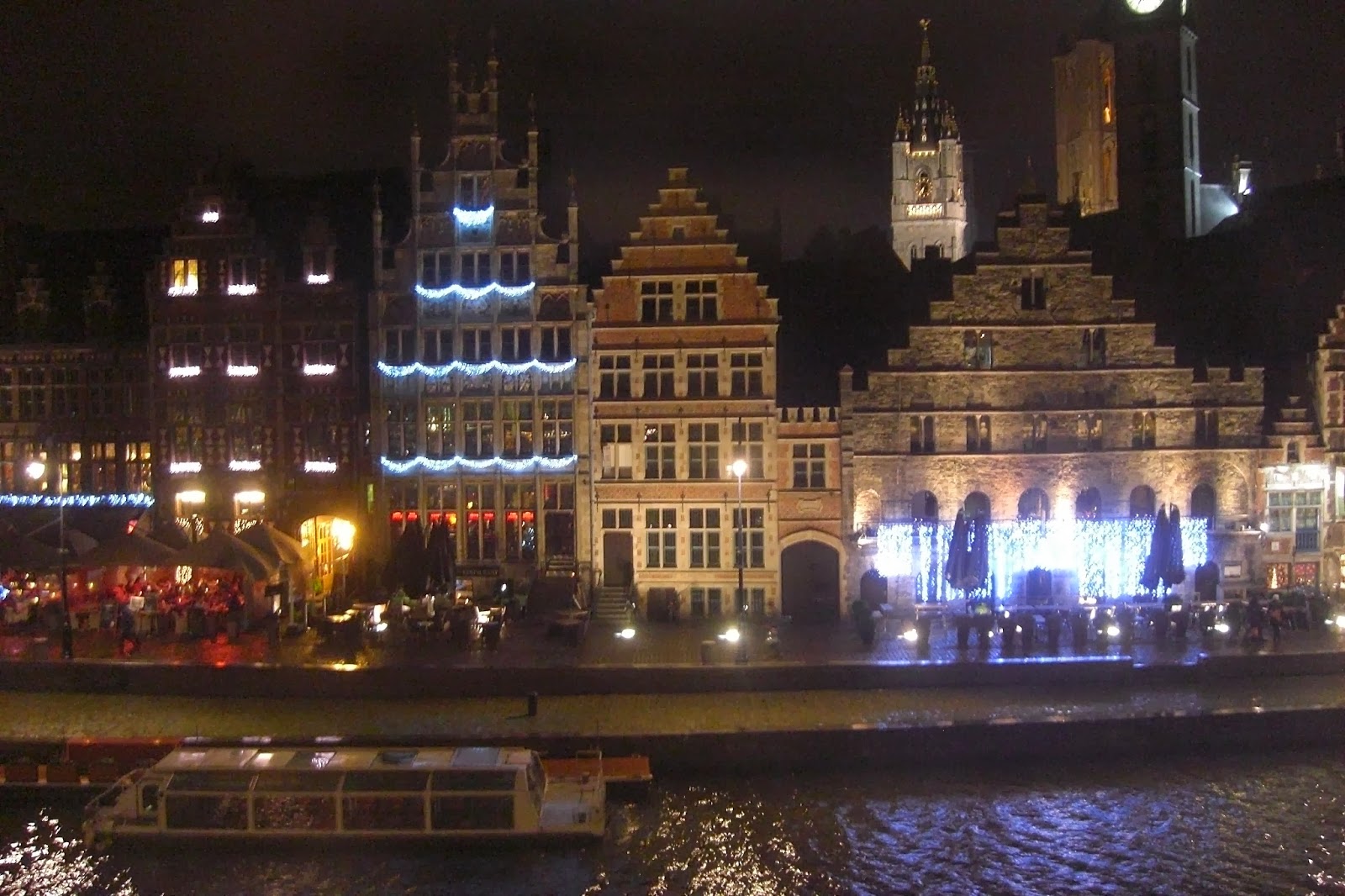
The Graslei at night.
With its film and music festivals, Ghent has become a hip Belgian town to visit during the summer and autumn months. But in winter, this Flemish city has an allure all its own, with festive lights reflecting off the many canals, monuments that one can view without being elbowed by crowds of tourists, and atypical exhibitions mounted just for the season.

The lights around the “three-tower” historical centre are at their most striking in winter, decorating the façade of the medieval buildings on the Graslei, for instance. At night, and especially in the early morning, this old port takes on an added charm, as the colours mirrored in the waters of the Leie make visitors feel like they’re in a famous Flemish painting.

A short distance away, one can find the three buildings that many people travel to Ghent to see: the imposing St Bavo’s Cathedral, the 95-metre-high Belfry with its shiny copper dragon, and the gothic Saint Nicholas Church.

The Cathedral houses many art treasures but is best known for “The Adoration of the Mystic Lamb”, a 12-panel altarpiece (and masterpiece) painted in 1432 by the brothers Hubert and Jan van Eyck. The work features astounding details of religious iconography and tells a multi-faceted story of the birth of Christ.

Houses along the Leie
The painting has also seen some turbulent times, having been carted off during various conflicts and even damaged by fire. One panel, “The Just Judges”, is still missing after being stolen in 1934; in its place is a reproduction by another artist.

Ghent town officials launched new restoration work on the altarpiece last September, and this is scheduled to last at least five years. In the meantime, St Bavo’s Cathedral is still displaying two-thirds of the original work, while black-and-white replicas stand in for the panels being restored.

After seeing “The Adoration”, one can climb the stairs to the top of the Belfry for a view of the city that inspired the Van Eycks. The Belfry, one of the tallest bell towers in the world, is a UNESCO World Heritage site, and the dragon on top of the tower is said to be a symbol of “Ghent’s independence”. The dragon has been there since 1380, “watching over the city”, as Ghent experienced invasions, mercantile bustle, rebellions, wars and liberation.

Inside St. Nicholas' Church
From the Belfry, one can admire St. Nicholas’ Church, built in Tournai bluestone in what’s known as the Scheldt Gothic style, named after the region’s Scheldt river. Now considered an architectural gem, particularly because of its grand tower above the crossing of the nave and transept, the church was almost turned into a grain hall during the French Revolution, when all of the city's churches were closed to religious services. Despite being looted, the building survived, however, and has undergone periodic renovation and refurbishing since then.

Down from the Belfry, one can venture inside St. Nicholas’ to hear its organ and see its shiny, elaborate interior after more than 30 years of restoration work.

A different perspective of the city comes from St Michaels Bridge (Sint Michielshelling) with the river stretching in both directions and the three towers of the city lined up as if for the perfect photo.  Then it’s time to explore Ghent’s quirky medieval streets, calm and quiet in winter.

Like most of Belgium, the city gets its fair share of rain. Yet, when one least expects it, there will be a sun-filled day, with the light glinting off the tops of the gable roofs and being reflected in the water of the city’s myriad canals. 

The Castle of the Counts
The streets north of the Graslei lead to the daunting Castle of the Counts (Gravensteen), where one can view dungeons and a torture museum, or just imagine time-travelling back to the 12th century when the castle was built by  Philip I, Count of Flanders. In winter, with the early falling of dusk, the castle seems even more imposing than in the summer months when the daylight lasts until late evening.

Ghent is also the birthplace of Charles V, Holy Roman Emperor, who was born there in 1500. His statue can be found a few streets away from the Gravensteen, on the Prinsenhof Plein. He seems to have had surprisingly short legs.

He would probably have ridden through the Patershol, the medieval centre of Ghent, with its narrow well-preserved houses along the cobblestone streets. One can now rent a bike (no horses) from the Tourist Office, but the buildings are best admired as one strolls leisurely through the area, remembering to speak in a low voice. Many of the houses bear signs asking visitors to be quiet because “the residents are sleeping”. Revelers during the summer no doubt create quite a ruckus.

The Graslei in the early morning.
The visitors expected for January’s Ghent Light Festival should be less noisy, as only sounds of awe tend to accompany the sight of the city being made into "a living light exhibition”, as the organizers describe it.

Last year the Festival simulated the burning of the Belfry, through the play of lights, and in January 2015, for the third edition of the festival, visitors can expect to feel the same kind of childish excitement brought on by a good fireworks show, as "artistic illumination" makes Ghent sparkle. - L. McKenzie & J.M. De Clercq

Sunday, November 24, 2013

‘GIRL IN DIOR’ ADDS TO THE LORE

French designer Christian Dior, who died in 1957 at the age of 52, remains a mythical figure, and Jeune fille en Dior will only add to the legend.

Cover of "Jeune fille en Dior".
This graphic novel by Annie Goetzinger tells the story of a young woman named Clara who works for a fashion magazine. She loves going to fashion shows and trying to spot stars such as Rita Hayworth and Marlene Dietrich. 

One day she proposes a photo shoot for Dior models and takes them to an outdoor market. But when a model grabs an apple as a cute accessory, she is attacked by an aggressive market vendor, and a nasty fight ensues. The magazine fires Clara but by then everyone at Dior knows her name.

She visits the couture house and meets the designer himself, who is charmed by her stories of her family’s interest in dressmaking; her grandmother also made clothes. Sometime later, Clara is called in to replace a pregnant model, and in this rags-to-couture story, the clothes make the girl.

Wearing Dior, Clara attracts interest and admiration and ends up marrying a wealthy man who takes her round the world. He unfortunately dies a few years later in a shipwreck, and Clara is plunged into sadness, with not even the luxurious garments of Dior able to lift her spirits.

Hearing the news of her misfortune, the designer calls and invites her to his latest fashion show, and he also takes her to lunch. In an optimistic mood, Dior tells her about his plans to go to Italy for a “cure” and to pass his business to his apprentices, including a young Yves Saint Laurent. “I will leave them a thriving company, celebrated throughout the world,” Dior says in the book.

A page from the book.
Days later, as she visits Dior’s birthplace in Normandy, Clara learns that the designer has died of a heart attack in Montecatini, Italy. “The date was 24 October 1957” when she heard the news, the author specifies.

She also notes that Clara is a fictional character meant to pay homage to Dior – “a tireless designer loved by his employees” who, in the space of 10 years, became a legend in the haute couture world.

The final section of the book gives chronological information on Dior’s life and his shows, including the private défilé put on for Britain’s queen and her sister in 1950. It also defines the various kinds of material such as tweed, tulle and shantung (a type of silk from the Chinese province of Shandong) used in fashion. 

The factual information enriches what might have been just another comic book. But the stilted style of the drawings, though evocative of the period, might not be to everyone's taste. (Publisher: Dargaud, Paris) - L. McKenzie & J.M. De Clercq

Wednesday, October 16, 2013

MEXICO SHOWS FRIDA AND DIEGO IN BLACK AND WHITE

Their unique story of love and art has been celebrated in movies and books, but there is always more to discover about Frida Kahlo and Diego Rivera.

Frida types a letter dictated by Diego
protesting the destruction of his fresco
at Rockefeller Center. May 1933, New York.
Anonymous. Newspaper image. 
The two icons of Mexican art are the subject of at least three exhibitions currently taking place in Paris, France, ranging from a huge show of their paintings side by side at the Musée de l’Orangerie to an exposition of period photographs at the Mexican Cultural Institute.

Titled “Complicities”, the photography exhibition in particular will be an eye-opener for those already familiar with Rivera’s larger-than-life murals and Kahlo’s vivid and disturbing portraits.  It puts the artists in their social and historical context, framing them against the background of the Mexican Revolution and the politics of their time.

“The exhibition is a road show that the Ministry of Foreign Affairs has put together and it has been shown in other countries, but this is the first time in France," said Sara Valdés, the minister-counselor for cultural affairs at the Mexican Embassy in France and director of the Cultural Institute.

“We have produced this particular show with fresh printings of original photographs because we thought it was very useful to show it during the Diego and Frida art exhibition as it gives the historical perspective to their art in the first half of twentieth-century Mexico,” she told Tasshon.

The remarkable black-and-white photographs, drawn from Mexico’s archives, show the famous couple working together, demonstrating together, and meeting with the leading cultural and political figures of the era.

Frida in the garden
by Leo Matiz (1917-1998)
Xochimilco, Mexico circa 1941
© Foundation Leo Matiz
The exhibition begins with images from the revolution and takes viewers through “the life and the role of this couple, whose work has its background in the Mexican Revolution”, said Valdés.

“Not only were they lovers, militants and painters, but they also symbolized an entire generation of change in modern Mexico,” she added.

Some of the most moving photos in the exhibition show the artists’ final moments. There is Kahlo staring solemnly at the camera in her last public appearance, 11 days before her death in 1954, and a terminally ill Rivera painting in his studio in 1955.

A separate section of the exhibition, billed as a show in its own right, is devoted to the work of the accomplished Colombian-born photographer Leo Matiz, who took personal and “up-close” photographs of the artists on a variety of occasions. These clear, beautifully shot pictures reveal a different side of Kahlo, portraying her in relaxed, feminine poses, or enjoying herself in the company of friends. One photo, on a kind of surreal level, actually looks like a publicity image for the popular film that actress Salma Hayek made about Kahlo’s life.

Matiz’s work is the “jewel in the crown” according to Valdés, and viewers to the exhibition will likely remember these evocative photographs for a long time, especially that of the artists as a young couple – smiling, joyful and seeming to look into the future.  - L. McKenzie

("Complicities: Frida and Diego" runs from 16 Oct. to 20 Dec. 2013)

Thursday, October 3, 2013

DESIGNER LIE SANG BONG HITS HIGH FINAL NOTE IN PARIS

Closing out Paris Fashion Week on Wednesday, Korean designer Lie Sang Bong –we have to say it – played not one note wrong.

Lie Sang Bong: black & white
Consistently among the few stylists who truly understand the concept of “ready-to-wear”, Lie presented designs that anyone would be happy to step into at a moment’s notice. Playfulness, elegance, simplicity and colour were the hallmarks of his 2014 spring/summer collection, and those lucky enough to see it gave him a rousing ovation.

By the time his show took place at the imposing Palais des Beaux Arts by the River Seine, the carnival-like atmosphere of Paris Fashion Week had dissipated, and what was left was a real appreciation for artistry. So Lie probably knew he couldn’t disappoint his loyal following.

His show began with strikingly simple black and white outfits, including for instance a white vest over a lace-detailed black dress, paired with black high heels. He presented different compositions with the same colours, all evoking a kind of carefree, careless classiness.

Another black dress, cinched at the waist, flowed outwards, with a pink floral hem, while a white blouse bore a red rose and black circles for vivid contrast with slim-fit dark trousers.

As the show progressed, the white and black garments gradually incorporated blues, reds and greens, mostly in floral designs. Then came vibrant colours, with Lie inviting viewers to imagine “petals swirling in the wind … petals exploding like fireworks”, as the ultra-feminine dresses moved to bright pink and florals.

After this burst of vibrancy, the outfits went back to black, though keeping with the theme of flowers. Lie finished with a “rose to burst like a storm”, presenting a billowing white maxi dress imprinted with huge black flowers.

It was a fitting end to the nine frenetic days of Paris Fashion Week. - J.M. De Clercq & L. McKenzie
(Photos: J.M. De Clercq)


Lie Sang Bong's closing statement. (Photo: De Clercq)

SHIATZY CHEN DRAWS ON SCENIC PAST FOR NEW COLLECTION

A Shiatzy chen design
Cubism, childhood memories, colourful landscapes. These were all joyously reflected in Shiatzy Chen’s 2014 spring/summer collection during Paris Fashion Week, which ended Oct. 2.

After 35 years in the fashion business, the label’s chief designer Wang Chen Tsai-Hsia gave herself free rein to “splash out”, as she incorporated some of her boldest colours to date in youthful yet stylish garments.

Dazzling orange, vivid reds, soft pinks, and imperial yellow contrasted with pale cream hues and black geometric lines, all on luxurious fabrics such as satin and silk. Added to this was the innovative use of traditional embroidery, as Chen played with the features of Chinese opera masks as well as ink paintings.

“She has really evolved,” said Jin Zhu, a fashion-media professional from Shanghai, China. “The collection was a little bit girly, and she added some sporty elements.”

A detail from a blouse.
“She was channelling Picasso and other artists,” added her colleague Vico Mao, also from Shanghai.

Jin and Ma were just two of the scores of viewers from Asia who came to France to see the collections of Chen and other designers. The crowds at Chen’s shows in particular have grown tremendously since she began participating in Paris Fashion Week over the past decade.

Presented at the iconic Grand Palais, the latest show drew celebrities as well as art-lovers who’ve become enamoured of Chen’s signature style, which blends an Eastern vogue with Western tailoring. The A-line skirts and straight-cut pants, combined with the fabrics, could be worn to any event demanding a certain level of sophistication.

In fact, several women in the audience showed off designs from Chen’s fall/winter collection, presented at the same venue earlier this year. One outfit that got the cameras clicking comprised a gold brocade skirt and jacket, worn by someone who seemed to be some sort of celebrity. We were too busy to ask her name. - J.M. De Clercq & L. McKenzie

Shiatzy Chen